OP141, Research Paper-PS3, Sabotage Publications-11: Wiley, Human Resource Management
https://www.rozen-bakher.com/iccg/op141
Latest Update: 27 July 2023
Research Paper: PS3
Rozen-Bakher, Z. Do Labour Unions Lead to a Failure of Mergers & Acquisitions (M&As)?: Game Theory Analysis (PS3) Link: https://www.rozen-bakher.com/publications/ps3
Abstract. This study raises the question of whether labour unions lead to a failure of Mergers & Acquisitions (M&As) due to the political infighting during the integration stage between the players, namely: management, buyer’s union and seller’s union. The study used the Game Theory to explain the non-cooperative games that arise between the players during the integration stage. The study presents a novel set of labour unions variables: the buyer’s union, the seller’s union, M&As with one union (buyer or seller), M&As with two unions (buyer and seller) and M&As without labour unions. The results show that an M&A with two labour unions leads to a ‘lose-lose scenario’ that indicates a negative influence on both the revenue and profitability. The study suggests that an M&A with two labour union leads to conflicts during the integration stage due to the ability to form a coalition between two players against a third player, which negatively influence the M&A performance. Nevertheless, the study reveals that an M&A with one labour union, especially the seller’s union leads to a ‘win-win scenario’ that reflect a positive influence on both the revenue and profitability. The study concludes that an M&A with two labour unions (buyer and seller) has a high risk for failure, while an M&A with one labour union (buyer or seller) creates opportunities for success. The study highlights the importance of using Game theory to explain the political infighting between the labour unions.
Publisher: Wiley, USA
The publisher Wiley is a Suspected Conspirator due to the scope of submissions that involved cyber-submission with their journals without giving explanations for these occurrences. On the one hand, the publisher Wiley avoided giving cover-up answers for the cyber incidents, but on the other, the publisher Wiley NEVER come back with outcomes about the checking of these cyber incidents, despite the promise to do it. In other words, the method of ‘We will check and come back to you’ was repeated in numerous submissions, yet without resolving the repeated cyber-submissions nor coming back with explanations, so it becomes useless to continue reporting to the publisher Wiley about each cyber case.
Journal: Human Resource Management (USA)
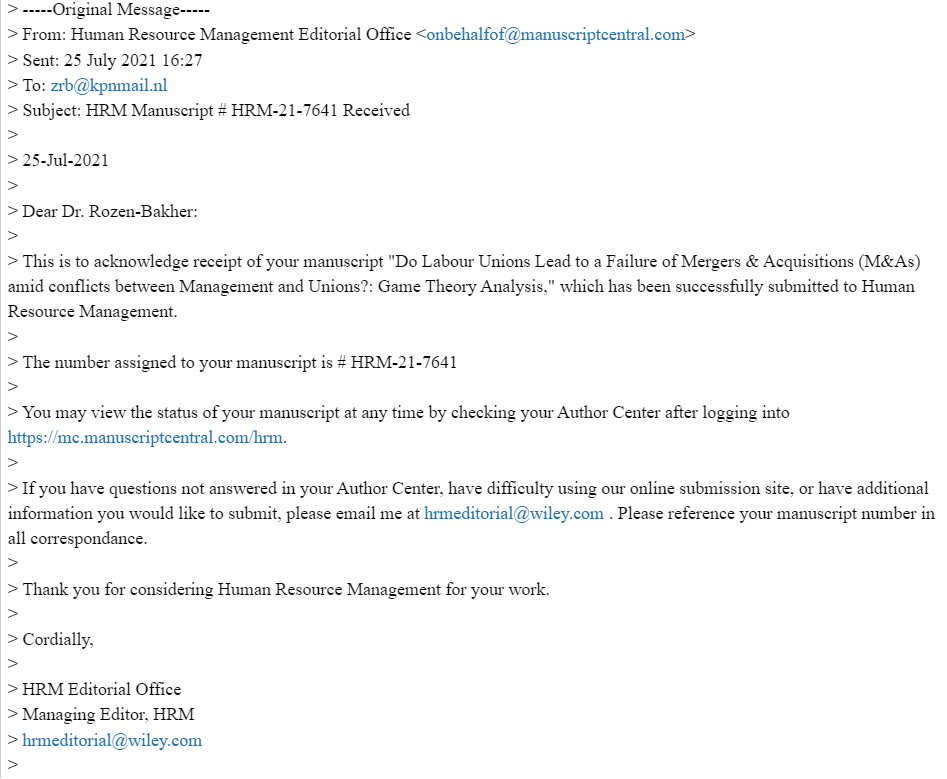
Manuscript Number: HRM-21-7641
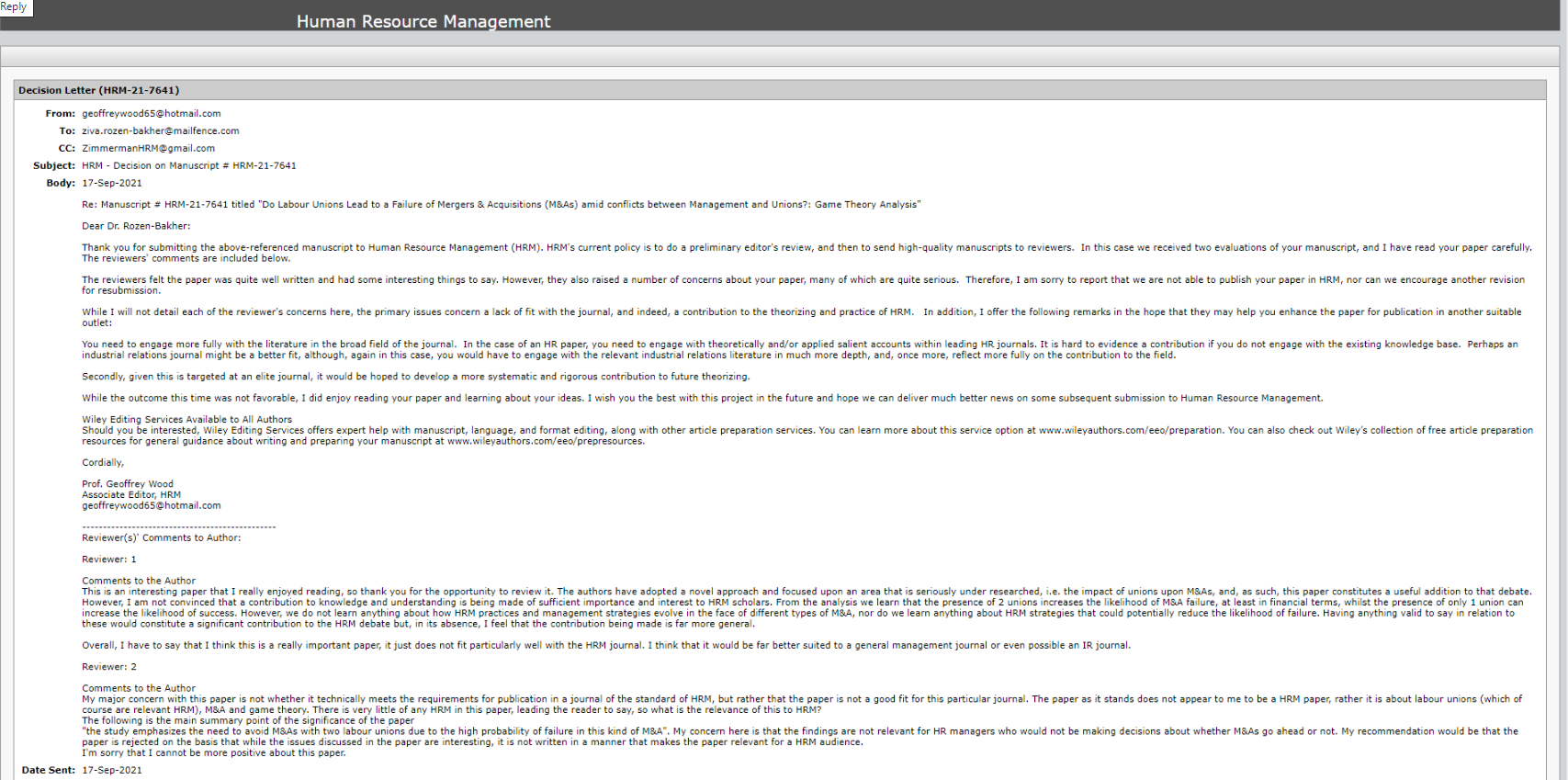
Ground for Legal Dispute: Intentionally Review Reject Reports by Reviewers-Conspirators and by Editor Conspirator
Method: Conspirators
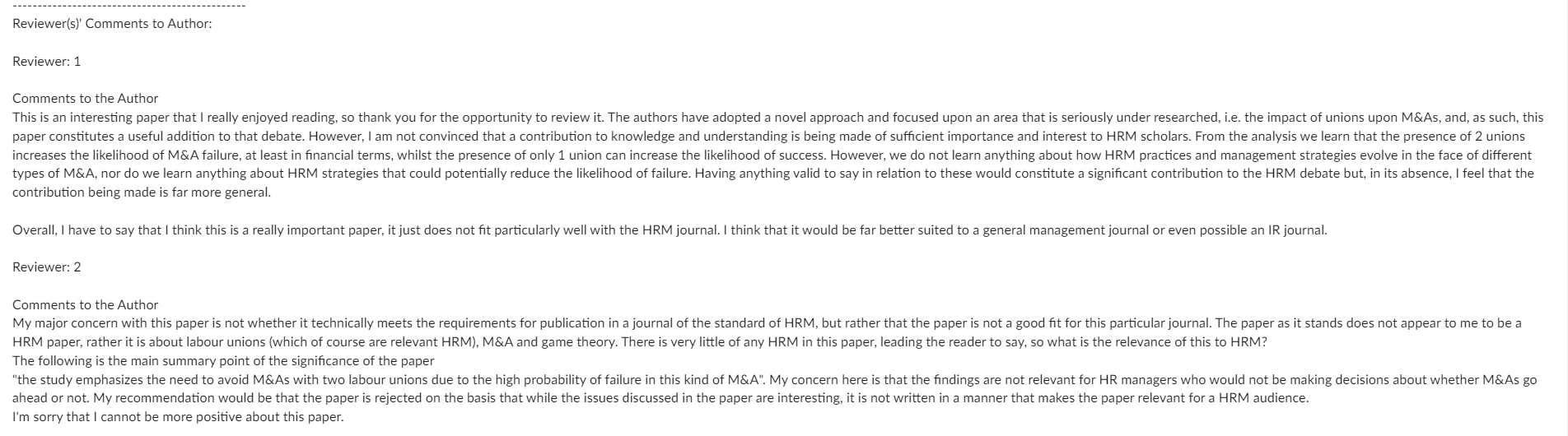
Both reviewers were provided a similar format of a very short review report that reject the paper based on a false argument that the paper does not fit to HRM journal, despite that identifying organizational political infights and diffusing them is one of the most important issues in HRM, especially when it occurred due to conflicts with unions because it impacts negatively the firm performance. Please see the textbooks on HRM below.
Banfield, Paul, Rebecca Kay, and Dean Royles. Introduction to human resource management. Oxford University Press, 2018. (Please see Chapter 8 - Managing Employees Relations and Chapter 12 - Managing Performance)
Part X - Employee Relations in Armstrong, M. (2020). Human resource management practice. Kogan (Please see Part X - Employee Relations and also part VII).
Buchanan, D. A., & Huczynski, A. A. (2019). Organizational behaviour. Pearson UK. (Please see Chapter 21- Conflicts and Chapter 22 - Power and Politics, as well as Part III - Groups.)
The similarity between the review reports in terms of the short length based on the same false argument signals that the review reports were coordinated by a ‘conspirator’.
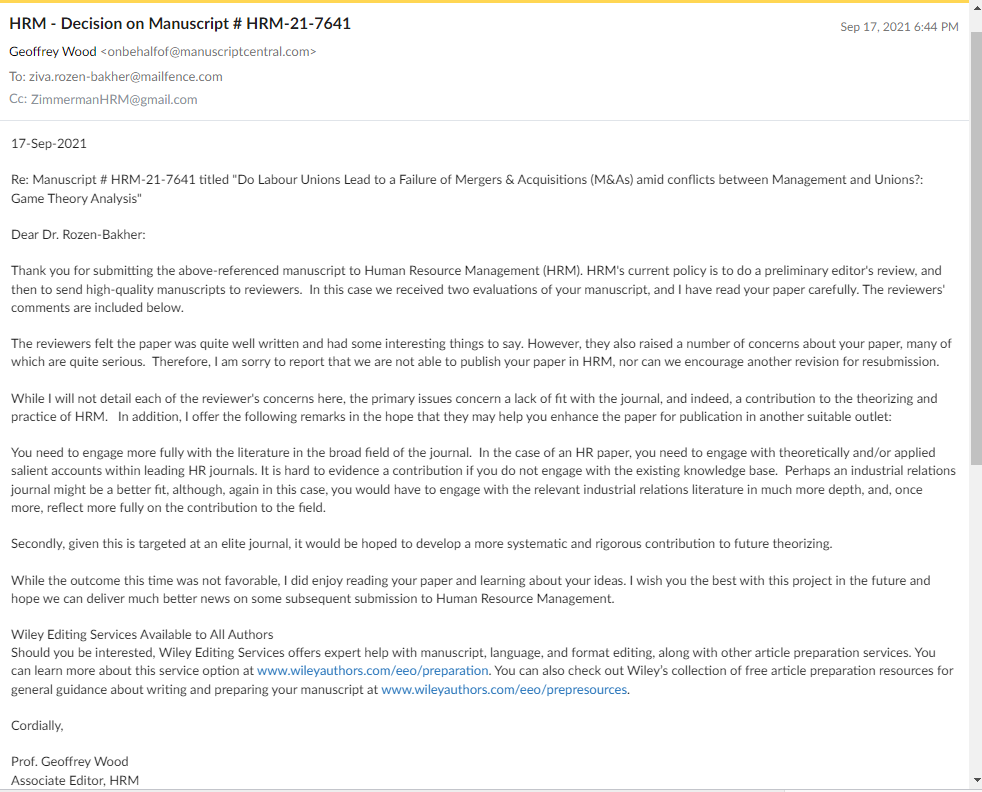
The rank of the journal is 4*, so it’s unclear how an editor sent a paper for review if the paper does not deal with HRM. Given that, the letter decision of the editor signals that the editor is a conspirator because he agreed with the false argument of the reviewers: “the primary issues concern a lack of fit with the journal”. Worse, the editor mentioned: “The reviewers felt the paper was quite well written and had some interesting things to say. However, they also raised a number of concerns about your paper, many of which are quite serious.”, however, the reports of the reviewers did not raise any concerns, either simple or serious ones, because their reports were very short without any comments excluding the false argument that the paper does not fit to HRM. Hence, likely, that the plan from the beginning was to send the paper for review with the outcome of reject to hold the paper for a few months during the review. That explains the similarity between the review reports in terms of short length and the same false argument without any comments, as well as the inherent contradiction that an editor of 4* journal does not send a paper for review if the topic of the paper it's not in the scope of the journal.
Important Note: Dr. Rozen-Bakher worked as a Lecturer (Permanent Faculty Member) in WGC-Bar Ilan University for over 10 years, during the years 2005-2014. She worked in parallel in two units namely, in the Political Sciences Department alongside in the Division of Human Resource Studies. During this period, she developed 16 courses including courses in Human Resources Management and Organizational Behaviour that were approved both by Bar Ilan University and by the Israeli Council for Higher Education. During the years 2010-2014, she carried out several courses per year in Human Resources Management under the Program of Bar Ilan University. Dr. Rozen-Bakher was awarded twice as Outstanding Lecturer of the Political Sciences Department in the years 2012 and 2013. For more details, see full CV.