AES - Alliance of Sahel States
https://www.rozen-bakher.com/alliances/aes
Published Date: 27 May 2026
COPYRIGHT ©2023-2026 ZIVA ROZEN-BAKHER ALL RIGHTS RESERVED
Rozen-Bakher, Z, Alliance of Sahel States (AES), Monitoring Alliances by Dr. Ziva Rozen-Bakher, https://www.rozen-bakher.com/alliances/aes
Monitoring Alliances by Dr. Ziva Rozen-Bakher
Monitoring Alliances by Dr. Ziva Rozen-Bakher: Monitoring Main Multilateral Trade/ Political/ Economic Alliances, as well as Multilateral Military Defence Treaties (MMDTs), Bilateral Military Defence Treaties (BMDTs), and Foreign Military Presence
Rozen-Bakher, Z. Monitoring Alliances by Dr. Ziva Rozen-Bakher https://www.rozen-bakher.com/monitoring-alliances

Dr. Ziva Rozen-Bakher
Researcher in International Relations and Foreign Policy with a Focus on International Security alongside Military, Political and Economic Risks for Foreign Direct Investment (FDI) and International Trade
For Explanation about Military Defence Treaty versus Military Support Treaty versus Military Cooperation, please see Section B2 in Section B. Introduction: Why do we need a Global Survival Rank?, 2024 Global Survival Rank (GSR) by Dr. Ziva Rozen-Bakher, https://www.rozen-bakher.com/gsr/2024/e/introduction
Alliance of Sahel States (AES)
The Alliance of Sahel States (Alliance des États du Sahel (AES)) includes three African countries: Burkina Faso, Mali, and Niger, which all of them formally withdrew from the African Union (AU) and its African Standby Force (ASF) of ECOWAS due to the suspension of their membership by the African Union, because of the military coups that took place in Burkina Faso, Mali, and Niger during the years 2021-2023, as has happened too many to count in Africa (Look for Military Regime in PD5). This isolation led to the creation of the Alliance of Sahel States (AES) by Burkina Faso, Mali, and Niger. First, they formed a Multilateral Military Defence Treaty (MMDT), and after that, they established the AES that includes trade, economic, and political aspects, and even with the prosperity to create a Free Movement of Persons and Goods as part of the AES, as well as the AES Investment Bank that will serve the three countries. Since the establishment of the AES, the superpowers have changed hands in these countries, namely Russia has become the patronage of AES, instead of Western countries. In 2025, Russia even signed a defence cooperation memorandum with AES during the joint summit in Russia, which makes Russia a “key external security partner for the AES countries” to promote “military training, logistical support, arms transfers, and intelligence coordination” (Source: ASA). Although recently, Russia even provided military air support to prevent rebels from capturing the capital and other key positions in Mali (Source: MSN).
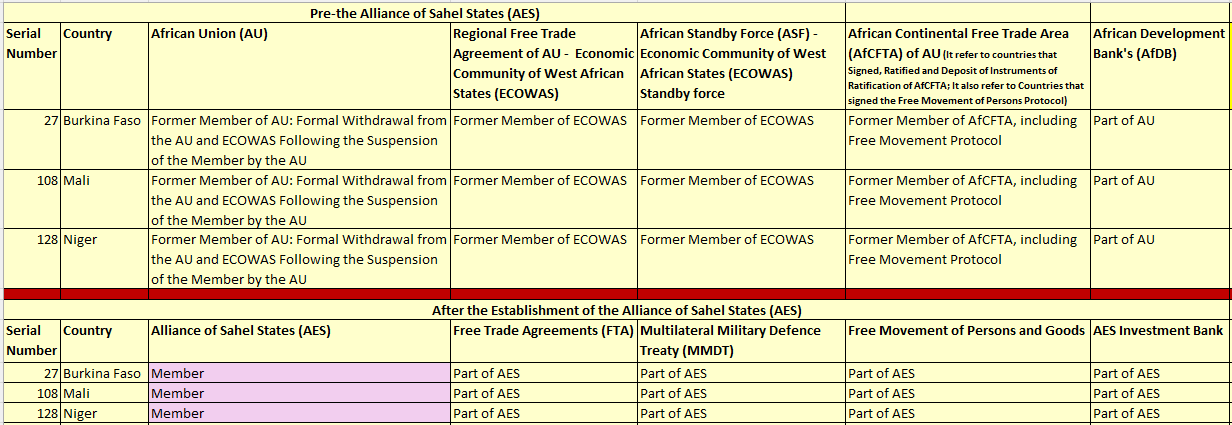
Full 25-point Declaration of AES https://lefaso.net/spip.php?article131446
Highlights from the 25-point Declaration of AES (Translation from French, source: Le Faso):
The Heads of State welcomed the results achieved through the coordinated actions of the three (3) States in the fight against terrorism within the Alliance's area of operation. They therefore decided to take a further step towards deeper integration among the member countries. To this end, they adopted the treaty establishing a Confederation between Burkina Faso, the Republic of Mali, and the Republic of Niger, called the "Alliance of Sahel States" Confederation, abbreviated as the AES Confederation.
They welcomed the establishment of a Joint Force of the Sahel States (FC/AES) at the meeting of Chiefs of Staff held in Niamey from 05 to 06 March 2024. This Force has the mission of implementing a permanent trilateral plan to combat armed terrorist groups, transnational organized crime and other threats faced by these countries.
The Heads of State welcomed their irrevocable and immediate withdrawal from ECOWAS. They also reaffirmed the full sovereignty of each of the ESA member countries in strategic choices contributing to the well-being of their populations.
On political issues, the Heads of State stressed the need for coordination of diplomatic action and the importance of speaking with one voice.
Regarding the free movement of persons and goods, the Heads of State instructed the relevant Ministers to urgently prepare draft additional protocols relating to this matter in order to address the implications of the withdrawal of the ESA States from ECOWAS.
The Heads of State stressed the need to pool their resources in order to implement structuring and integrative projects in strategic sectors, in particular:
– Agriculture and food security;
– Water and the environment; energy and mining;
– Trade and industrial transformation;
– Infrastructure and transport
– Communication and telecommunications;
– Free movement of people and goods;
– The digital economyThe Heads of State decided on the creation of an ESA Investment Bank and the establishment of a Stabilization Fund. To this end, they instructed the Ministers in charge of Foreign Affairs and those in charge of Development to take the necessary steps to make them operational.
Regarding communication within the framework of the AES, the Heads of State instructed the Ministers to implement an effective communication strategy to ensure accurate information for the public through increased use of national languages in public and private media. They also decided to establish certified digital platforms featuring narratives that reflect the aspirations of the people.
The Heads of State stressed the importance of ensuring better coordination in the monitoring and implementation of decisions from the various sessions of the College of Heads of State. They also welcomed the establishment of National AES Committees in the three (3) countries to ensure better coordination.
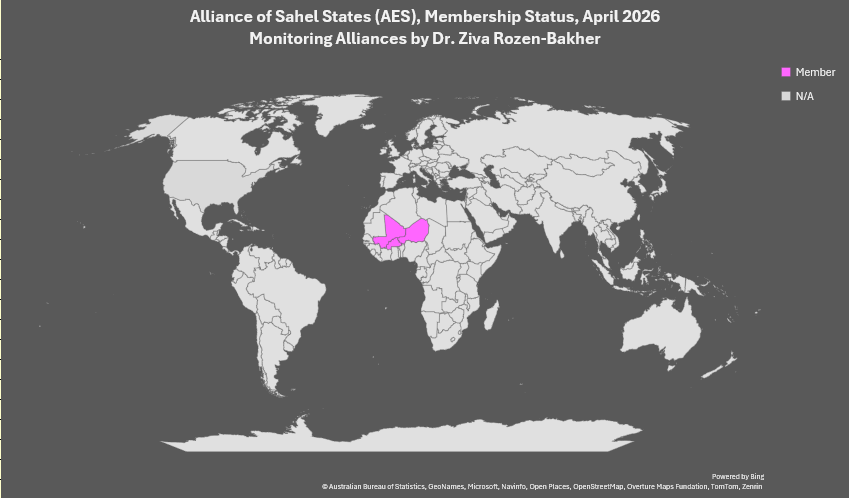
Map of AES by Membership Status
List of AES by Membership Status, sorted by Alphabetical Order
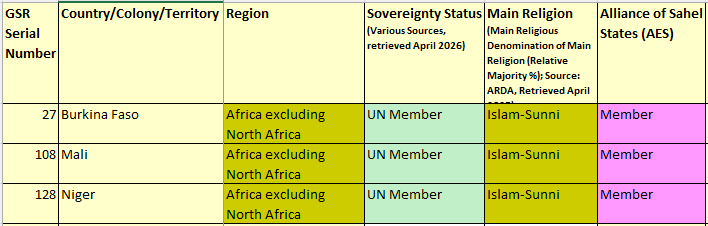
AES by Global Survival Rank (GSR)
Stay Tuned for the 2026 Global Survival Rank (GSR)
AES Members by the Blog on Foreign Direct Investment (FDI) and International Trade by Dr. Ziva Rozen-Bakher
Rozen-Bakher, Z. Blog on Foreign Direct Investment (FDI) and International Trade by Dr. Ziva Rozen-Bakher by Alphabetical Order https://www.rozen-bakher.com/search-blog-1
The copy of this section was carried out under the cyber of ICCG
· Rozen-Bakher, Z. , Burkina Faso, Blog on Foreign Direct Investment (FDI) and International Trade by Dr. Ziva Rozen-Bakher, 24 May 2021, https://www.rozen-bakher.com/blog/2021/05/24/burkina-faso
· Rozen-Bakher, Z. , Mali, Blog on Foreign Direct Investment (FDI) and International Trade by Dr. Ziva Rozen-Bakher, 16 June 2021, https://www.rozen-bakher.com/blog/2021/06/16/mali
· Rozen-Bakher, Z. , Niger, Blog on Foreign Direct Investment (FDI) and International Trade by Dr. Ziva Rozen-Bakher, 29 September 2022, https://www.rozen-bakher.com/blog/2022/09/29/niger
Relevant Items From the Research Projects of Dr. Ziva Rozen-Bakher
Look for Military Regime: Rozen-Bakher, Z. (2021). A Regime Type as a Location Factor of FDI: Democracy, Communism, Absolute Monarchy, Religious Regime, and Military Regime. Unpublished Research Paper, PD5. https://www.rozen-bakher.com/unpublished-research-papers/pd5
Rozen-Bakher, Z., Africa in the Hand of Russia-China Coalition: The Colonialism Backfire on the USA Coalition, Risks Timeline by Dr. Ziva Rozen-Bakher, 20 November 2022, https://www.rozen-bakher.com/timeline-risks/20/11/2022/1522
From Scientific Literature - Research Papers and Research Books
Military coups in West Africa: An analysis of the formation of the alliance of Sahel Kipo-Sunyehzi, D. D., & Lambon, P. J. (2025). Military coups in West Africa: An analysis of the formation of the alliance of Sahel. Africa review, 17(3), 237-250.
An Investigation of Economic Implications of Withdrawal of Alliance of Sahel States (AES) From ECOWAS Sebego, M., Ouedraogo, I. M., & Folawewo, A. O. (2026). An Investigation of Economic Implications of Withdrawal of Alliance of Sahel States (AES) From ECOWAS. African Development Review, 38(1), e70051.
A Theoretical Analysis of Security-Led Integration: The Case of Alliance of Sahel States (AES). Arhin, C. A. (2025). A Theoretical Analysis of Security-Led Integration: The Case of Alliance of Sahel States (AES). International Journal of Research and Innovation in Social Science, 9(9), 3276-3288.
Regional Security at a Crossroads: The Emergence of the Alliance of Sahel States Adunimay, A. W., & Lifongo, M. (2026). Regional Security at a Crossroads: The Emergence of the Alliance of Sahel States. Journal of African Union Studies, 15(1), 117.
The Alliance of Sahel States, Democratic Relapse, Insecurity, and the Prospects of Regional (Dis) integration or (Re) integration in West Africa Aina, F., Afolabi, B., & Fayemi, J. K. (2025). The Alliance of Sahel States, Democratic Relapse, Insecurity, and the Prospects of Regional (Dis) integration or (Re) integration in West Africa. Society, 1-15.
Türkiye-Alliance of Sahel States Relations Mustapha, A. B. (2024). Türkiye-Alliance of Sahel States Relations. Insight Turkey, 26(3), 203-222.