Foreign Military Presence in Host Countries
https://www.rozen-bakher.com/alliances/foreign-military-presence
Latest Update: 28 May 2026
COPYRIGHT ©2023-2026 ZIVA ROZEN-BAKHER ALL RIGHTS RESERVED
Rozen-Bakher, Z, Foreign Military Presence in Host Countries, Monitoring Alliances by Dr. Ziva Rozen-Bakher, https://www.rozen-bakher.com/alliances/foreign-military-presence
Monitoring Alliances by Dr. Ziva Rozen-Bakher
Monitoring Alliances by Dr. Ziva Rozen-Bakher: Monitoring Main Multilateral Trade/ Political/ Economic Alliances, as well as Multilateral Military Defence Treaties (MMDTs), Bilateral Military Defence Treaties (BMDTs), and Foreign Military Presence
Rozen-Bakher, Z. Monitoring Alliances by Dr. Ziva Rozen-Bakher https://www.rozen-bakher.com/monitoring-alliances

Dr. Ziva Rozen-Bakher
Researcher in International Relations and Foreign Policy with a Focus on International Security alongside Military, Political and Economic Risks for Foreign Direct Investment (FDI) and International Trade
For Explanation about Military Defence Treaty versus Military Support Treaty versus Military Cooperation:
Section B2 in Section B. Introduction: Why do we need a Global Survival Rank?, 2024 Global Survival Rank (GSR) by Dr. Ziva Rozen-Bakher, https://www.rozen-bakher.com/gsr/2024/e/introduction
For explanations about Foreign Military Presence:
Section C3. Foreign Military Presence in Host Countries: Trade-off between Military Benefits and Military Risks, Section C. Military Risk in Wars, 2025 Global Survival Rank (GSR) by Dr. Ziva Rozen-Bakher https://www.rozen-bakher.com/gsr/2025/c/military-risk
Section D4.9 Foreign Military Presence in Host Countries (M9),Section D. Methodology, 2025 Global Survival Rank (GSR) by Dr. Ziva Rozen-Bakherhttps://www.rozen-bakher.com/gsr/2025/d/methodology
Section D6.15 Methodology Note XV: Explanation about the Database of Foreign Military Presence in Relation to Colonies, MMDTs and BMDTs, Section D. Methodology, 2025 Global Survival Rank (GSR) by Dr. Ziva Rozen-Bakherhttps://www.rozen-bakher.com/gsr/2025/d/methodology
Foreign Military Presence in Host Countries
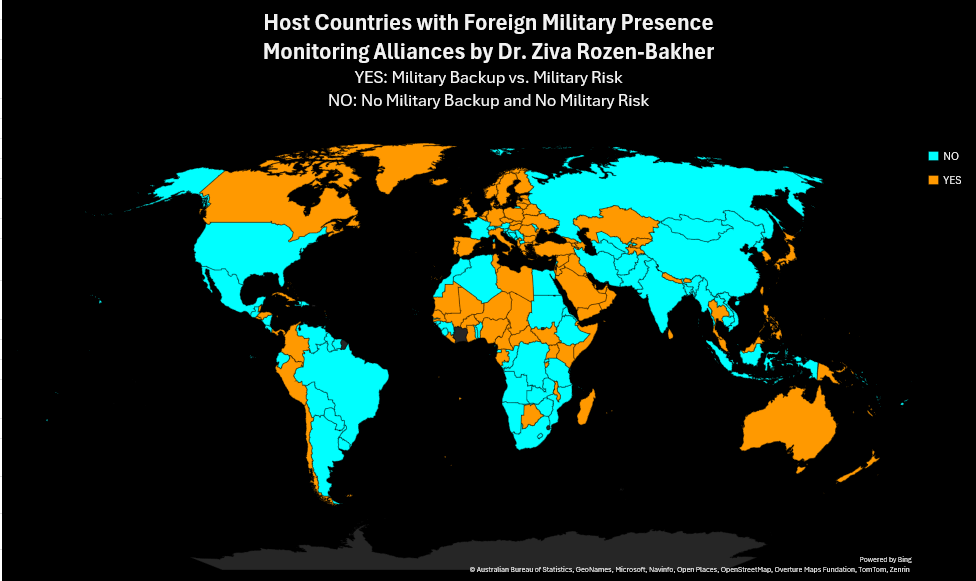
Foreign Military Presence in Host Countries gives an important layer about the Military Backup versus Military Risk that the Host Country has when Foreign Military bases and installations are located in the host country or, vice versa, about the Military Imperialism and Military Risk that the Home Country has when the Home Country has multiple distant Host countries with extensive Foreign Military Presence. The recent USA-Israel War against Iran gives a very good example for the Military Risk that the Host Country has when attacks carried out from Foreign Military bases that located in its territory, such as what happened when the USA attacked Iran from its bases in five GCC countries, and in retaliation, Iran attacked the USA bases in GCC countries, resulting in the situation that the five GCC countries were complicated in the war only because they have Foreign Military Presence and because they did not object that the USA will attack Iran from their territories. Still, the recent USA-Israel War against Iran gives also a clear indication about the military risk that the home country has when the home country needs to protect many military bases under attacks, which even worsen when the home country needs to mobilize forces from the home country that located very far from the war zone, as what happened to the USA when the USA was needed to mobilize forces from the USA that located around 10,000 km from Iran. Thus, it can be argued that a long distance from the home country increases significantly the military risk of Military Imperialism, especially when the war involve many host countries with too many military bases and installations, as what happened to the USA in the recent war against Iran. Importantly, it is an illusion to think that Military Imperialism gives military backup to the home country, because it does not contribute to the defence of the home country, but instead, a Military Imperialism even burdens on the home country in terms of military spending and the dispersion of the military capabilities because of the need to simultaneously handle too many foreign military bases and installations in host countries, which significantly increases the military risk of the home country, especially if the home country also has colonies with military bases.
Hence, from the Host Country perspective, there is a Trade-off between the Military Benefits and the Military Risks regarding Foreign Military Presence. On the one hand, Foreign Military Presence gives some Military Backup to the host country, but on the other, Foreign Military Presence is not a Multilateral Military Defence Treaty (MMDT) or Bilateral Military Defence Treaty (BMDT), so paradoxically, it does not promise any commitment to defend in the case of an attack as exist in MMDTs or BMDTs. The agreement between the USA and Jordan about the USA’s Foreign Military Presence in Jordan is a good example of lack of the commitment to defend in the case of an attack (see Cite 8 in Section C3). More specifically, according to Article 6 on Security from the USA-Jordan agreement (see Document 2 in Section C3), not only that the USA have no commitment to defend Jordan in the case of an attack, but the opposite, Jordan should defend the USA’s personnel and installations in Jordan (see Clause 1 in Document 2 in Section C3), and Jordan is even primarily responsible for the security in Jordan outside the USA’s facilities (see Clause 4 in Document 2 in Section C3), so the USA has no any commitment to defend Jordan in the case of an attack. Worse, if attacks and wars carried out from the host country as happened in the recent USA-Israel War against Iran, then the host countries suffer from retaliation attacks as happened to the five GCC countries and Jordan. Hence, paradoxically, during the last years, not only that the GCC countries and Jordan not have more security, but the opposite, they have suffered from retaliation attacks against the USA’s bases and installations in their territories. For this reason, the constitutions of many countries prohibit Foreign Military Presence due to the Military Risk and the fear of complicity in others’ wars.
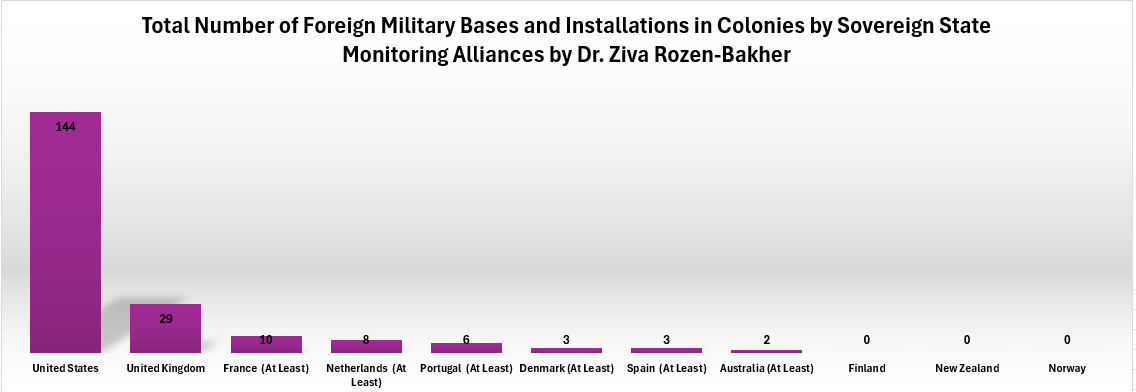
Even from the Home Country perspective, exists a Trade-Off between the Military Benefits and the Military Risks regarding Foreign Military Presence. On the one hand, Foreign Military Presence gives the home country strategic military points around the world, especially if the home country implements a policy of Military Imperialism as in the case of the USA that has numerous host countries with Foreign Military Presence. On the other hand, if the home country has too many host countries with Foreign Military Presence, then it burdens on the military capabilities of the home country, which significantly increases the military risk of the home country, especially if the home country also has colonies with military bases.
In the light of the above, here are the Typology of Foreign Military Presence in relation to Military Backup versus Military Risk:
Non-Foreign Military Presence: No Military Backup and No Military Risk
Foreign Military Presence in Host Countries: Military Backup versus Military Risk
Foreign Military Presence in Colonies: Military Imperialism with Military Risk
Host Country Perspective of Foreign Military Presence: Military Backup versus Military Risk
Home Country Perspective of Foreign Military Presence: Military Imperialism with Military Risk but without Military Backup
Foreign Military Presence in Colonies by Sovereign State: Military Imperialism with Military Risk but without Military Backup
Importantly, Military Backup can be achieved via Foreign Military Presence, but mainly via MMDTs and BMDTs, as follows:
Multilateral Military Defence Treaties (MMDTs): Military Backup, yet most MMDTs do not formally cover Colonies (e.g., NATO)
Bilateral Military Defence Treaties (BMDTs): Military Backup for the weak country, while Military Backup for the strong country only if the BMDT has BMDT with Two-Directions of Commitment
Rozen-Bakher, Z, Military Alliances Led by Russia and China: MMDTs and BMDTs, Monitoring Alliances by Dr. Ziva Rozen-Bakher,https://www.rozen-bakher.com/alliances/rcm
Rozen-Bakher, Z, Military Alliances Led by USA: MMDTs and BMDTs, Monitoring Alliances by Dr. Ziva Rozen-Bakher, https://www.rozen-bakher.com/alliances/usa-military
Considering the above, the list below presents the Full List of UN Members and Non-UN Members by Foreign Military Presence vs. Non-Foreign Military Presence, yet the list takes into account the Host Country Perspective vs. Home Country Perspective vs. Sovereign State with Colonies, with the aim of getting complete picture about the Military Backup versus Military Risk that each country has.
Map of Host Countries with Foreign Military Presence
Map of Home Countries with Foreign Military Presence
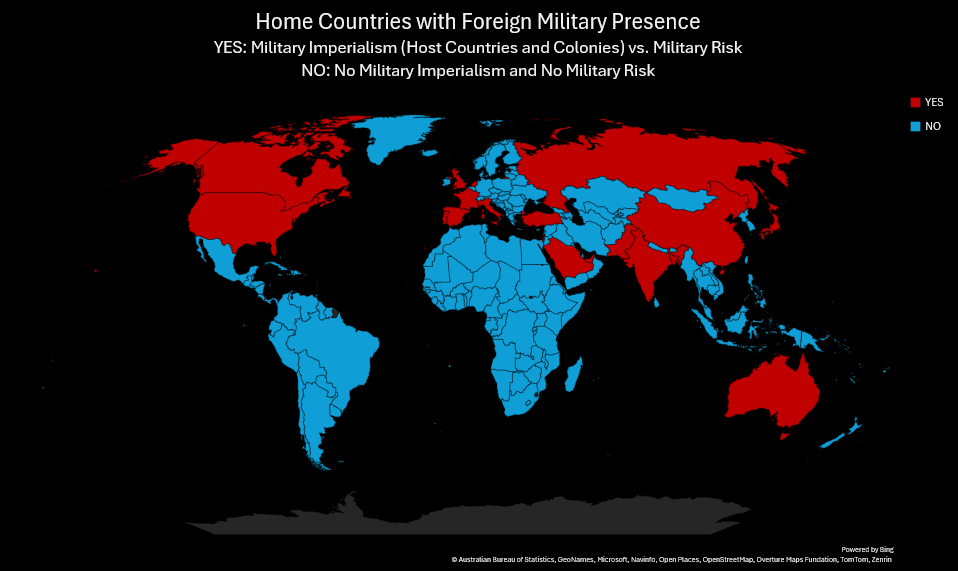
Chart of Total Number of Foreign Military Bases and Installations in Host Countries by Home Country
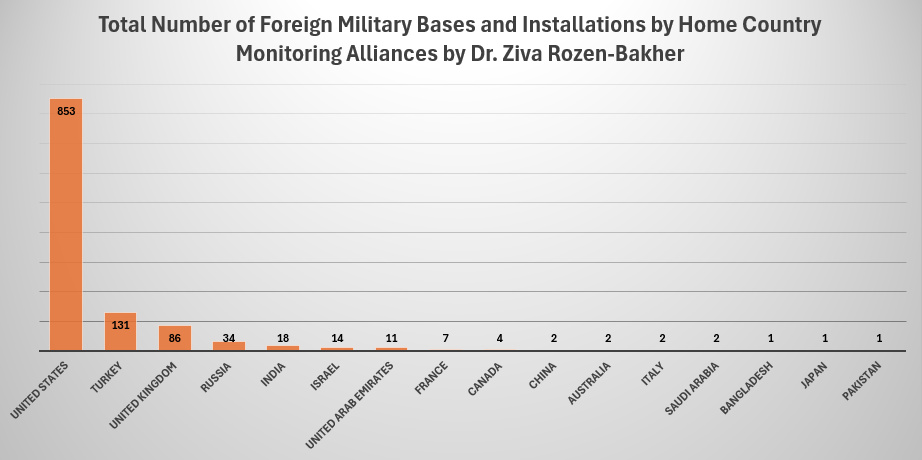
Chart of Total Number of Foreign Military Bases and Installations in Colonies by Home Country
Full List of UN Members and Non-UN Members by Foreign Military Presence/Non-Foreign Military Presence - Host Country Perspective vs. Home Country Perspective vs. Sovereign State with Colonies - sorted by Alphabetical Order
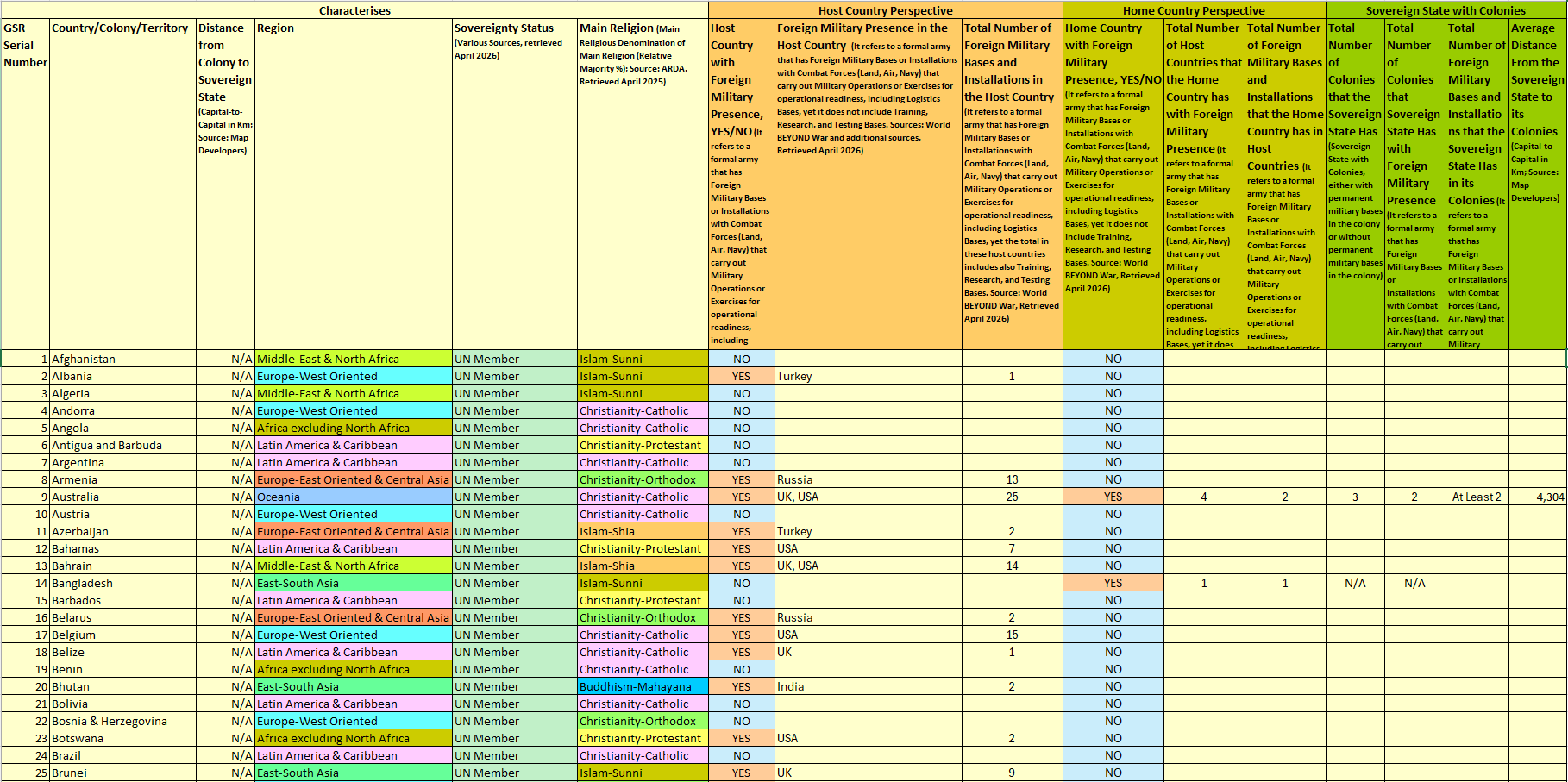
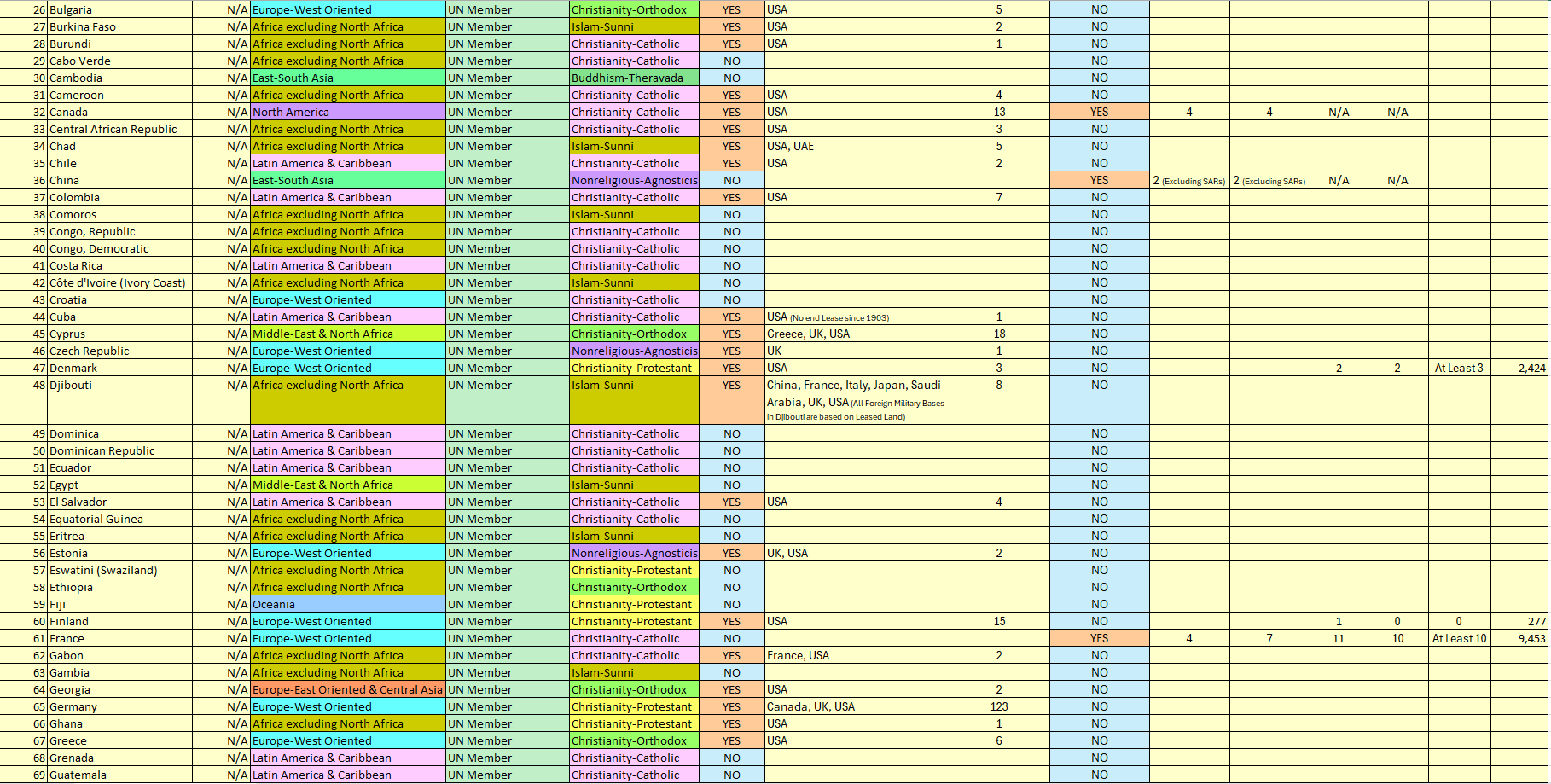
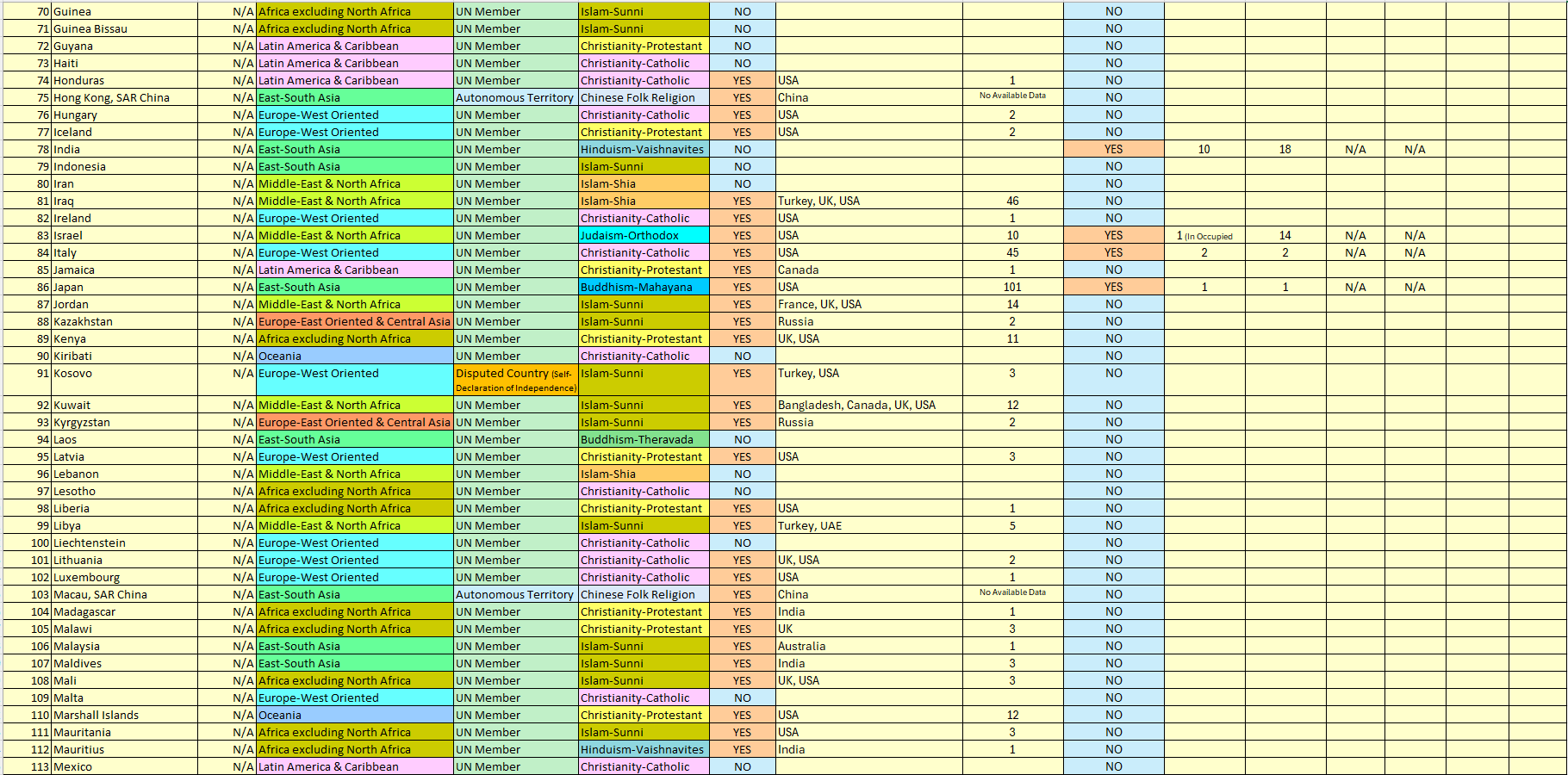
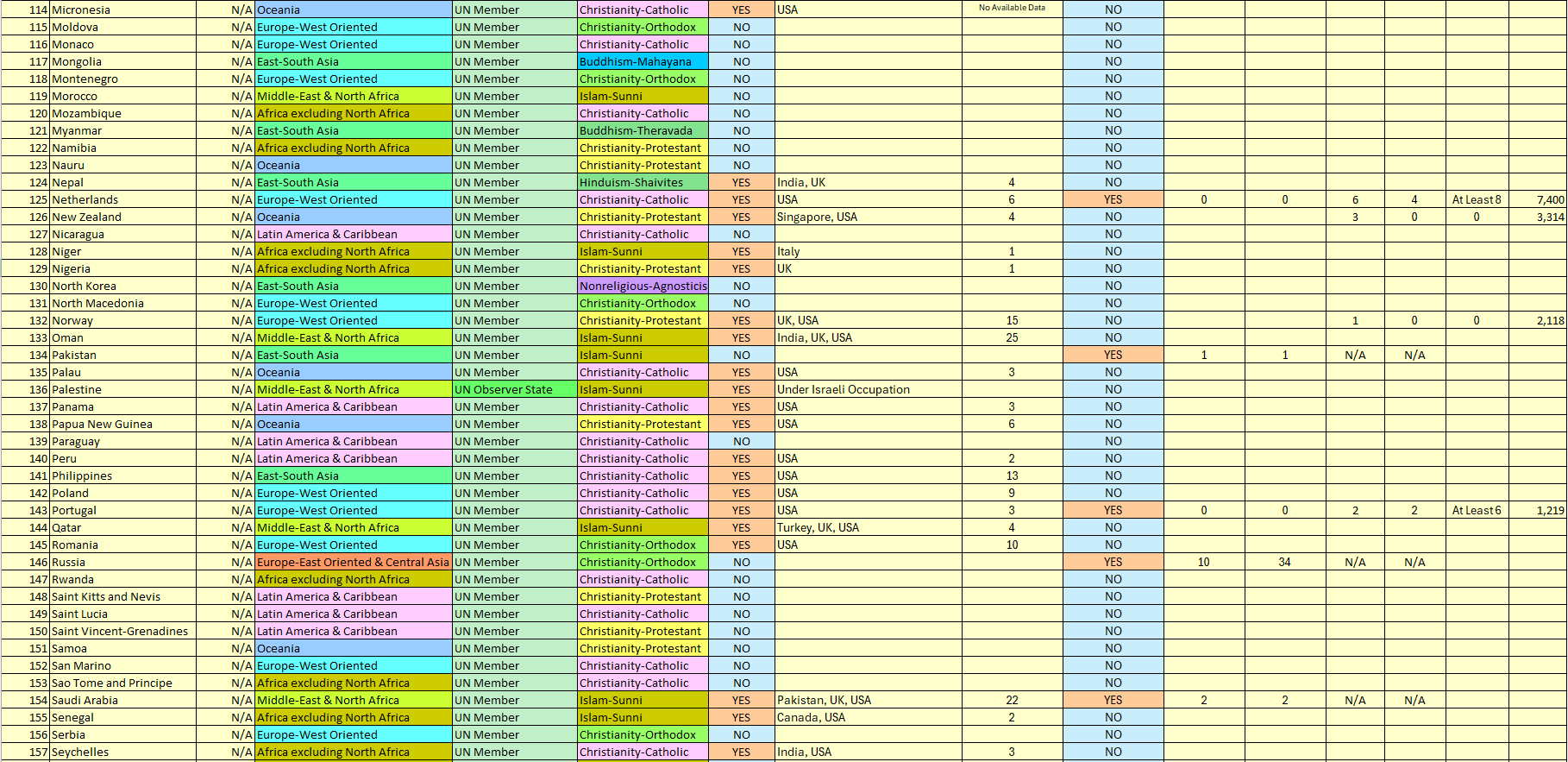
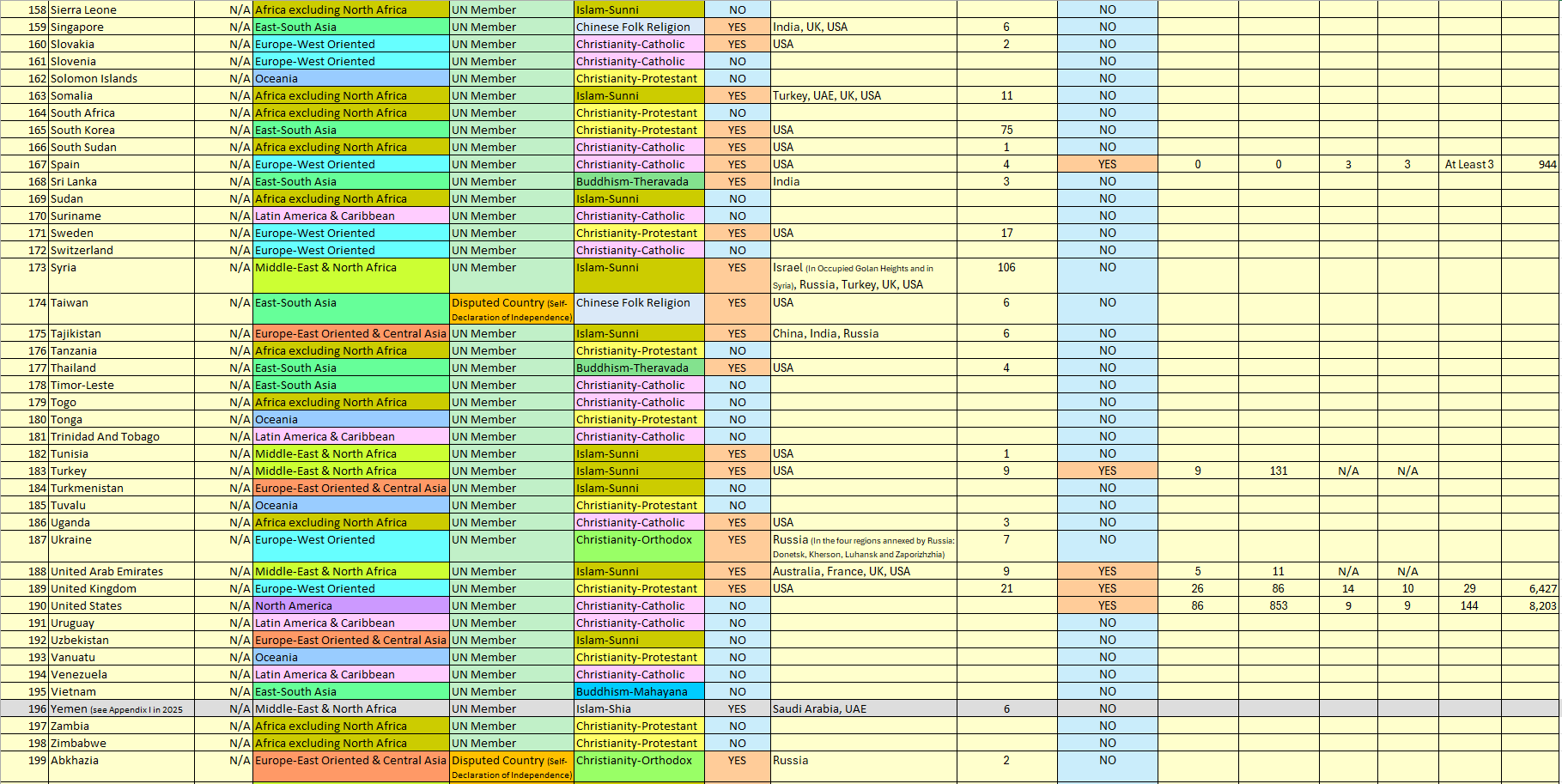
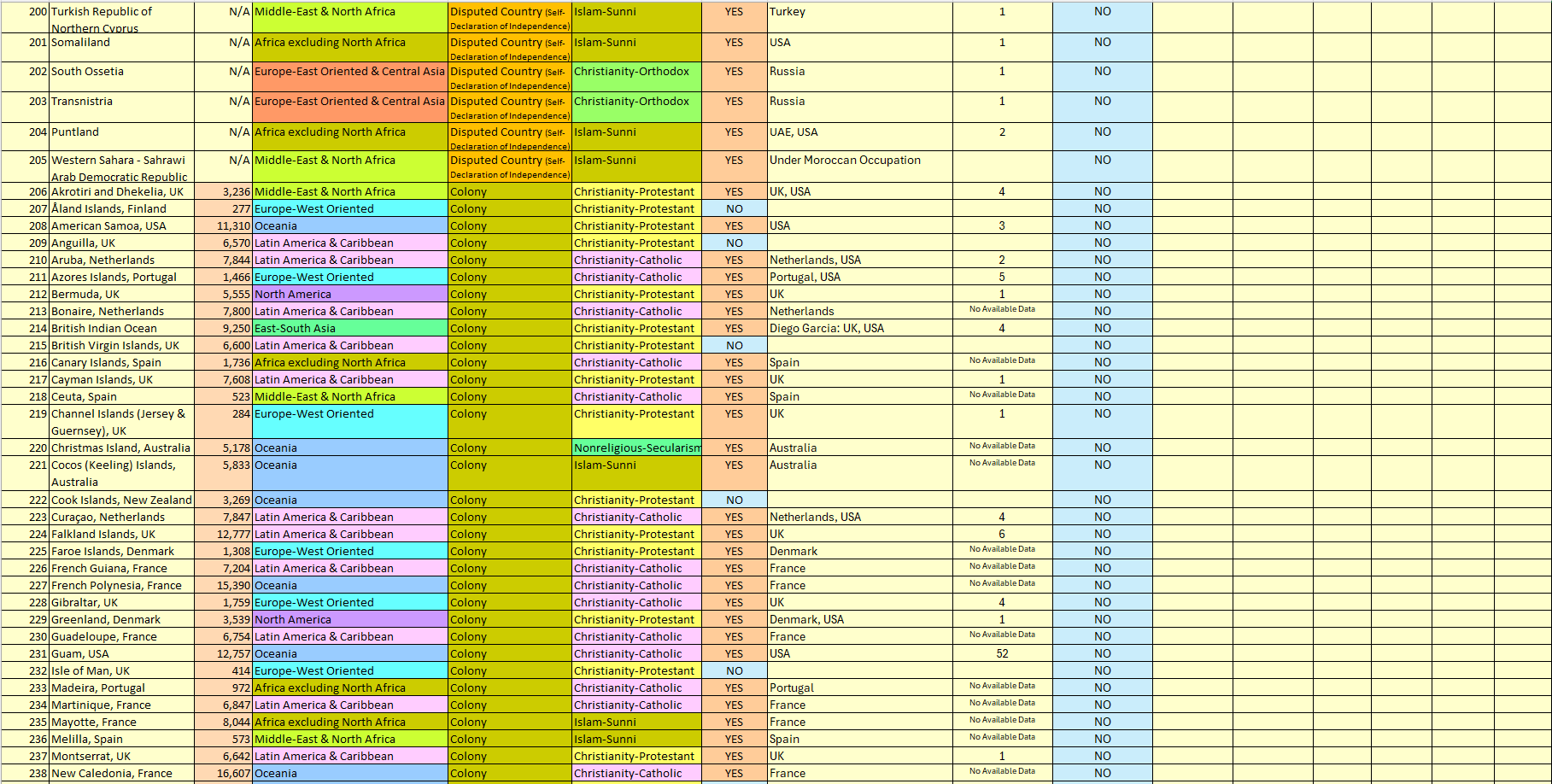
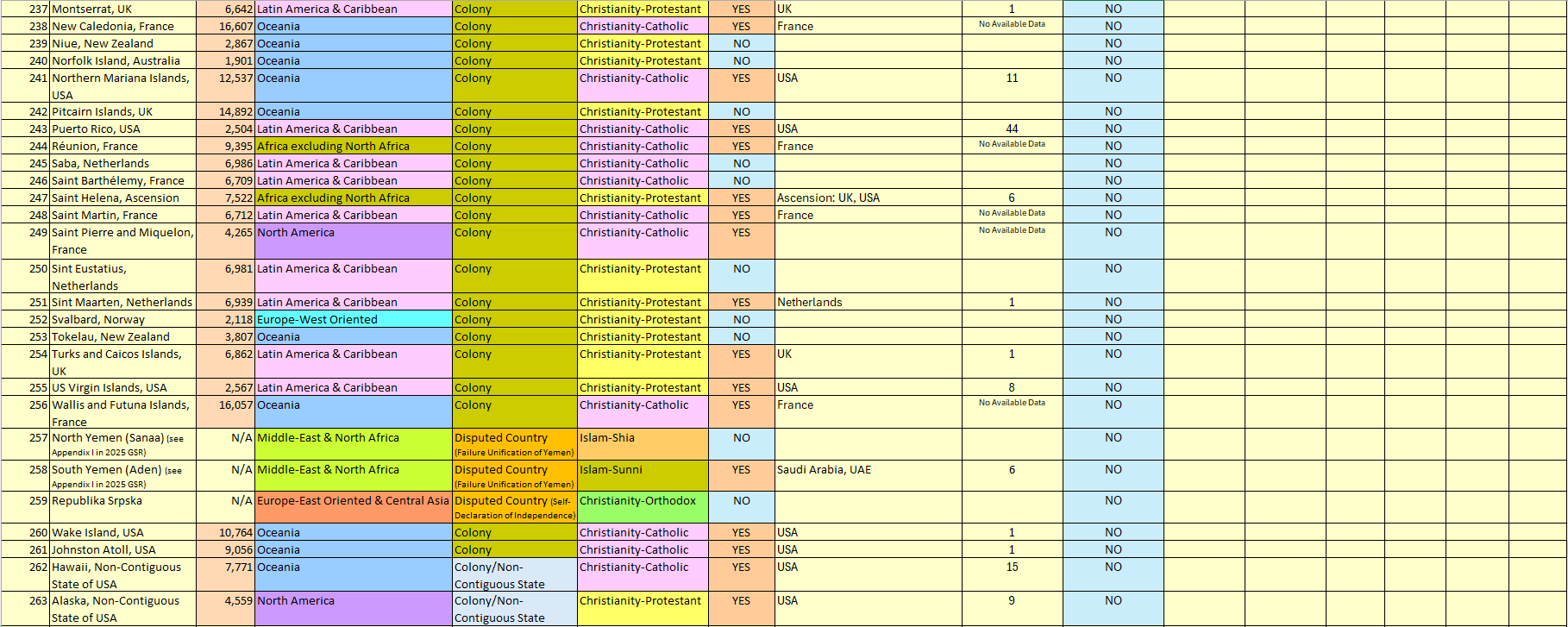
Foreign Military Presence by 2025 Global Survival Rank (GSR)
Section E10. Foreign Military Presence in Host Countries, 2025 Global Survival Rank (GSR) by Dr. Ziva Rozen-Bakher https://www.rozen-bakher.com/gsr/2025/e/foreign-military-presence
Section E10. Foreign Military Presence in Host Countries, 2025 Global Survival Rank (GSR) by Dr. Ziva Rozen-Bakher
Section E10.1 Foreign Military Presence, sorted by Alphabetical Order
Section E10.2 Host Country Perspective: Foreign Military Presence
Section E10.3 Home Country Perspective: Foreign Military Presence
Section E10.3.1 Home Country Perspective - Foreign Military Presence: Geopolitical Position
Section E10.3.2 Home Country Perspective - Foreign Military Presence: Global Survival Rank Indicators (R1-R7)
Section F3. Comparison of Home Countries with Foreign Military Presence, 2025 Global Survival Rank (GSR) by Dr. Ziva Rozen-Bakher https://www.rozen-bakher.com/gsr/2025/f/comparison-fmp
Section F5.4 Comparison of Superpowers/Permanent Members of UNSC: Layer III - Military Risk of Military Defence Alliances, Colonies, Territories, and Foreign Military Presence in Host Countries, Section F5. Comparison of Superpowers/ Permanent Members of UNSC: Military Backup and Military Risk, 2025 Global Survival Rank (GSR) by Dr. Ziva Rozen-Bakher https://www.rozen-bakher.com/gsr/2025/f/comparison-superpowers
Section G5. Foreign Military Presence: High Risk for Home Countries that Have Many Host Countries, Section G. Concluding Risk Remarks and Future Perspectives, 2025 Global Survival Rank (GSR) by Dr. Ziva Rozen-Bakher https://www.rozen-bakher.com/gsr/2025/g
Relevant Items From the Research Projects of Dr. Ziva Rozen-Bakher
Rozen-Bakher, Z. (2000). The Impact of the Gulf War on the Israeli Threat Perception: Implications for the Israeli Security Policy. M.A. Working Paper in Hebrew, University of Haifa. https://www.rozen-bakher.com/s/2-a9ge.pdf
Rozen-Bakher, Z. (1999). The Attack of Iraq on Kuwait: The Failure of USA Administration to Predict the Attack M.A. Working Paper in Hebrew, University of Haifa. https://www.rozen-bakher.com/s/2-a9ge.pdf ; Presentation in Hebrew: USA's Failure to Predict the Iraqi Invasion of Kuwait https://www.rozen-bakher.com/s/Iraqi-Invasion-of-Kuwait.prn
Section F5. Comparison of Superpowers/ Permanent Members of UNSC: Military Backup and Military Risk, 2025 Global Survival Rank (GSR) by Dr. Ziva Rozen-Bakher https://www.rozen-bakher.com/gsr/2025/f/comparison-superpowers
Section G5. Foreign Military Presence: High Risk for Home Countries that Have Many Host Countries, Section G. Concluding Risk Remarks and Future Perspectives, 2025 Global Survival Rank (GSR) by Dr. Ziva Rozen-Bakher https://www.rozen-bakher.com/gsr/2025/g
D1.5 Sovereign States with Colonies, Section D. Analysis and Concluding Risk Remarks, 2024 Global Survival Rank (GSR) by Dr. Ziva Rozen-Bakher, https://www.rozen-bakher.com/gsr/2024/e/concluding-risk-remarks
Section E37. Superpowers - Military Defence Treaties in the Case of Attack against the Soil of the Superpower, 2024 Global Survival Rank (GSR) by Dr. Ziva Rozen-Bakher, https://www.rozen-bakher.com/gsr/2024/e/37
Rozen-Bakher, Z., The CIA’s Illusion about Restoring the Iranian Autocratic Monarchy through Reza Pahlavi, the Son of the late Shah of Iran, Risks Timeline by Dr. Ziva Rozen-Bakher, 08 January 2026, https://www.rozen-bakher.com/timeline-risks/12/01/2026/0538
Rozen-Bakher, Z., Did Trump Violate the USA’s Multilateral Military Defence Treaties (MMDTs) with a 'Clear Commitment' to Defend in the Case of an Attack?: The Cases of Rio Pact and NATO, Risks Timeline by Dr. Ziva Rozen-Bakher, 08 January 2026, https://www.rozen-bakher.com/timeline-risks/08/01/2026/0848
Rozen-Bakher, Z., King of Jordan: Not for Long?, Risks Timeline by Dr. Ziva Rozen-Bakher, 14 April 2024, https://www.rozen-bakher.com/timeline-risks/14/04/2024/1539
Rozen-Bakher, Z., Islamic Resistance in Iraq (IRI): Iraq Formally Joined the Military Campaign against Israel and USA Bases in the Middle East, Risks Timeline by Dr. Ziva Rozen-Bakher, 01 February 2024, https://www.rozen-bakher.com/timeline-risks/01/02/2024/1205
From Scientific Literature - Research Papers and Research Books
The Military Presence of Foreign Powers in the Horn of Africa: a Case of “Disrupting Rivalry” Sun, D., & Zoubir, Y. H. (2025). The Military Presence of Foreign Powers in the Horn of Africa: a Case of “Disrupting Rivalry”. African and Asian Studies, 1(aop), 1-29.
A Geo-Strategic Importance of Djibouti: Presence of Foreign Military Bases Ali, U., Bhatti, M. N., & Nawaz, A. (2025). A Geo-Strategic Importance of Djibouti: Presence of Foreign Military Bases. Social Sciences Spectrum, 4(2), 681-688.
Bases abroad: The global foreign military presence Harkavy, R. E. (1989). Bases abroad: The global foreign military presence. Stockholm International Peace Research Institute.
The foreign military presence in the Horn of Africa region Melvin, N. (2019). The foreign military presence in the Horn of Africa region.
Foreign military presence and the changing practice of sovereignty: A pragmatist explanation of norm change Schmidt, S. (2014). Foreign military presence and the changing practice of sovereignty: A pragmatist explanation of norm change. American Political Science Review, 108(4), 817-829.
Terrorist attacks targeting the police: the connection to foreign military presence Gibbs, J. C. (2018). Terrorist attacks targeting the police: the connection to foreign military presence. Police Practice and Research, 19(3), 222-240.
The significance of foreign military bases as instruments of spheres of influence Klin, T. (2020). The significance of foreign military bases as instruments of spheres of influence. Croatian International Relations Review, 26(87), 120-144.
Outside the wire: US military deployments and public opinion in host states Allen, M. A., Flynn, M. E., Machain, C. M., & Stravers, A. (2020). Outside the wire: US military deployments and public opinion in host states. American Political Science Review, 114(2), 326-341.
US military presence in the Gulf: Challenges and prospects Hajjar, S. G. (2002). US military presence in the Gulf: Challenges and prospects.
The politics of overseas military bases Yeo, A. I. (2017). The politics of overseas military bases. Perspectives on Politics, 15(1), 129-136.
US global military deployments, 1950–2020 Allen, M. A., Flynn, M. E., & Martinez Machain, C. (2022). US global military deployments, 1950–2020. Conflict Management and Peace Science, 39(3), 351-370.
China's soft military presence in the Middle East Degang, S. (2018). China’s soft military presence in the Middle East (Vol. 31). King Faisal Center for Research and Islamic Studies (KFCRIS).
US foreign military bases and military colonialism: Personal and analytical perspectives Gerson, J. (2009). US foreign military bases and military colonialism: Personal and analytical perspectives. The bases of empire: The global struggle against US military posts, 47-70.
US Foreign Military Bases: The Edge and Essence of Empire Lutz, C. (2015). US Foreign Military Bases: The Edge and Essence of Empire. In Rethinking America (pp. 15-30). Routledge.
Beyond the target state: Foreign military intervention and neighboring state stability Peksen, D., & Lounsbery, M. O. (2012). Beyond the target state: Foreign military intervention and neighboring state stability. International Interactions, 38(3), 348-374.
United States military forces and installations in Europe Duke, S. (1989). United States military forces and installations in Europe. Oxford University Press.
Armed guests: Territorial sovereignty and foreign military basing Schmidt, S. (2020). Armed guests: Territorial sovereignty and foreign military basing. Oxford University Press.
US military deployment and host-nation economic growth Heo, U., & Ye, M. (2019). US military deployment and host-nation economic growth. Armed Forces & Society, 45(2), 234-267.
The architecture of imperialism: military bases and the evolution of foreign policy in Egypt's New KingdomMorris, E. (2021). The architecture of imperialism: military bases and the evolution of foreign policy in Egypt's New Kingdom (Vol. 22). Brill.
US military bases and facilities in the Middle EastWallin, M. (2022). US military bases and facilities in the Middle East. American Security Project.
China's military base in Djibouti: A microcosm of China's growing competition with the United States and new bipolarity Cabestan, J. P. (2021). China's military base in Djibouti: A microcosm of China's growing competition with the United States and new bipolarity. In China’s Big Power Ambition under Xi Jinping (pp. 169-185). Routledge.
Base towns: Local contestation of the US Military in Korea and Japan Kim, C. J. (2023). Base towns: Local contestation of the US Military in Korea and Japan. Oxford University Press.
The militarization of Turkish foreign policy Mehmetcik, H., & Çelik, A. C. (2022). The militarization of Turkish foreign policy. Journal of Balkan and Near Eastern Studies, 24(1), 24-41.