Military Alliances Led by Russia and China: Multilateral Military Defence Treaties (MMDTs) and Bilateral Military Defence Treaties (BMDTs)
https://www.rozen-bakher.com/alliances/rcm
Latest Update: 25 May 2026
COPYRIGHT ©2023-2026 ZIVA ROZEN-BAKHER ALL RIGHTS RESERVED
Rozen-Bakher, Z, Military Alliances Led by Russia and China, Monitoring Alliances by Dr. Ziva Rozen-Bakher, https://www.rozen-bakher.com/alliances/rcm
Monitoring Alliances by Dr. Ziva Rozen-Bakher
Monitoring Alliances by Dr. Ziva Rozen-Bakher: Monitoring Main Multilateral Trade/ Political/ Economic Alliances, as well as Multilateral Military Defence Treaties (MMDTs), Bilateral Military Defence Treaties (BMDTs), and Foreign Military Presence
Rozen-Bakher, Z. Monitoring Alliances by Dr. Ziva Rozen-Bakher https://www.rozen-bakher.com/monitoring-alliances

Dr. Ziva Rozen-Bakher
Researcher in International Relations and Foreign Policy with a Focus on International Security alongside Military, Political and Economic Risks for Foreign Direct Investment (FDI) and International Trade
For Explanation about Military Defence Treaty versus Military Support Treaty versus Military Cooperation, please see Section B2 in Section B. Introduction: Why do we need a Global Survival Rank?, 2024 Global Survival Rank (GSR) by Dr. Ziva Rozen-Bakher, https://www.rozen-bakher.com/gsr/2024/e/introduction
Military Alliances Led by Russia and China:
Multilateral Military Defence Treaties (MMDTs) and Bilateral Military Defence Treaties (BMDTs)
Chart of Military Alliances Led by Russia and China with Clear Commitment to Defend in the Case of Attack
Green Line: Military Defence Treaty with Two-Directions Clear Commitment to Defend in the Case of Attack, either under Hard-Definition or Soft-definition
Orange Line: Military Defence Treaty with One-Direction Clear Commitment to Defend in the Case of Attack, either under Hard-Definition or Soft-definition
Blue Line: Multilateral Alliance with Military Cooperation and Joint Military Drills

Summary: The Chart above and the list of MMDTs and BMDTs below indicate that if a significant attack occurs against Russia and China, then both countries will act together to eliminate the threat via joint defence. Still, in the case of an attack against China, then China has the Military Backup from Russia and North Korea, namely China, Russia and North Korea will fight together against the attack. However, in the case of an attack against Russia, then Russia has the Military Backup from China, North Korea, Iran, and CSTO, which all of them will fight together to eliminate the attack against Russia, yet in both cases, Russia and China likely will also get military assistance or even more than that from countries that belong to SCO, BRICS and SIC. Hence, it can be argued that the bloc that includes Russia, China, North Korea, Iran, CSTO, and CIS can be considered as Counter-NATO, especially in the case of World War, while some members of SCO and BRICS will likely join the Counter-NATO, such as Brazil and South Africa, which regularly participate in joint drills of BRICS with Russia and China.
China-Russia Military Defence Treaty, 2001. The treaty is called the ‘Sino-Russian Treaty of Good-Neighbourliness and Friendly Cooperation’, yet it includes a ‘Hard-Medium Definition’ of a Military Defence Treaty, namely ”When a situation arises in which one of the contracting parties deems that peace is being threatened and undermined or its security interests are involved or when it is confronted with the threat of aggression, the contracting parties shall immediately hold contacts and consultations in order to eliminate such threats”. That means that in the case of an attack against Russia or China, the two countries will immediately conduct a consultation to eliminate the threat, namely the consultation aims to check if the country can eliminate the threat alone or if the country needs help to eliminate the threat via joint defence. Hence, clearly, Russia and China have a Military Defence Treaty that includes a commitment to defend each other in the case of an attack, yet the treaty takes into account that both countries, Russia and China, are big and strong countries that can eliminate many external threats alone, and because of that comes the consultation to understand if, under a certain attack, help is needed to eliminate the threat or not.
China-North Korea Military Defence Treaty, 1961. The treaty is called ‘Sino-North Korean Treaty of Friendship, Co-operation, and Mutual Assistance’, yet it includes a ‘Hard Definition’ of a Military Defence Treaty, namely that the two nations undertake all necessary measures to oppose any country or coalition of countries that might attack either nation.
Russia-North Korea Military Defence Treaty, 2024. The Soviet Union (USSR) and North Korea had a Military Defence Treaty that was signed in 1961 and it was valid until the dissolution of the Soviet Union in 1991 (see https://treaties.un.org/doc/Publication/UNTS/Volume 420/volume-420-I-6045-English.pdf). After the dissolution of USSR, Russia and North Korea had a Treaty of Friendship, but without a Military Defence Treaty. On June 2024, Russia and North Korea signed a Military Defence Treaty with ‘Two Directions’ based on ‘Hard Definition’, so since then, China-Russia-North Korea have Triple BMDTs that de-facto create an MMDT that includes the three countries. Importantly, following the Russia-North Korea MMDT, Russia activated the treaty in a way that North Korea has joined the Russian war against Ukraine.
Russia-Iran Military Defence Treaty, 2025. The new Iran-Russia Comprehensive Strategic Partnership Treaty includes a Soft-Definition of Military Defence Treaty between Russia and Iran, which expands the defence backup for Russia in the case of an attack while creating a defence backup for Iran in the case of an attack. Here are the highlights of the new Military Defence Treaty between Russia and Iran, as follows:
Article 5 Section 4. “The Contracting Parties shall consult and cooperate in countering common military and security threats of a bilateral and regional nature”.
Article 3 Section 3. “In the event that either Contracting Party is subject to aggression, the other Contracting Party shall not provide any military or other assistance to the aggressor which would contribute to the continued aggression, and shall help to ensure that the differences that have arisen are settled on the basis of the United Nations Charter and other applicable rules of international law”.
Article 5 Section 1. “The Contracting Parties shall strengthen their relations based on the principles of sovereign equality, territorial integrity, independence, non-interference in the internal affairs of each other, the respect for sovereignty, cooperation and mutual trust”.
Article 12. “The Contracting Parties shall facilitate bolstering of peace and security in the Caspian region, Central Asia, Transcaucasia, and the Middle East, cooperate to prevent interference in the specified regions and destabilizing presence of the third states there, and exchange opinions on the situation in other regions of the world”.
Article 14.“The Contracting Parties shall deepen cooperation within regional organizations, interact and harmonize positions within the Shanghai Cooperation Organization in the interests of strengthening its potential in the areas of politics, security, economy, and in cultural and humanitarian spheres, and facilitate the expansion of trade and economic ties between the Eurasian Economic Union and the Islamic Republic of Iran”.
Russia–Belarus Treaty on security guarantees within the Union State, 2024. Russia and Belarus are members of CSTO, but this security guarantee gives an additional pillar of military backup in the case of an attack. Importantly, this agreement “taking retaliatory measures not only to acts of aggression committed, but also to threats of their commitment” namely, “to prevent encroachments on security”. (Belarus ratified agreement with Russia on security guarantees).
China-Solomon Islands Security Pact, 2022. The China-Solomon Islands Security Pact can be considered as One Direction of a BMDT under a ‘Soft Definition’. Based on various open sources, the Security deal between China and the Solomon Islands includes a commitment of China to send military forces in the case of political instability in the Solomon Islands (political instability can occur due to coups, mass protests, riots and such), while in return, the Solomon Islands allows China Naval to use the Solomon Islands as a ‘Military Station’, including conducting aerial surveillance of the pacific islands, and importantly, China has the right to defend its assets and military personnel in the Solomon Islands in the case of an ‘external threat’, resulting in a Military Defence Treaty de-facto between China and the Solomon Islands. Still, it is One Direction of BMDT because only China has the commitment to defend the Solomon Islands from Internal and External threats, while the Solomon Islands has no obligation to do the same for China. Notably, the Solomon Islands are located in a strategic location in the Pacific near Australia, which gives China a military advantage in that location. Keep in mind, that significant Western countries have colonies in various important locations worldwide, which usually include military bases in those colonies, so a military pact in the style of China-Solomon Islands gives China a similar alternative to Western military bases in distant colonies.
CSTO. The CSTO is an MMDT that acts based on the principle that aggression against one member country would be perceived as aggression against all member countries. CSTO is a Military Alliance led by Russia that includes an additional 5 former Soviet countries: Armenia, Belarus, Kazakhstan, Kyrgyzstan, and Tajikistan. However, in June 2024, Armenia announced its intention to leave the CSTO, but since then, Armenia has not formally withdrawn from the CSTO, so it is doubtful if Armenia will make the move without securing its position in NATO or the EU. Moreover, the CSTO has several Informal Observer States that regularly participate in CSTO activities.
Multilateral Alliance Led by Russia and China with Significant Military Cooperation and Joint Military Drills but without a clear commitment to defend in the case of an attack, so they are not included in the List of MMDTs
CIS. The CIS has de-facto a Military Defence Treaty because the CIS has the ‘Council of Defence Ministers’ that is responsible for the Military Cooperation, including for the operation of the Headquarter (MCCH) that is located in Moscow. Importantly, in 1995, the CIS established a joint ‘CIS Air Defence System’ that includes Units of Air Defence of the CIS Members under the control of the ‘Air Defence Coordination Committee’ of the ‘CIS Council of Defence Ministers’, with the aim of protecting the Air Boundaries of the CIS members, including giving Early Warning for Air/Missile Strikes alongside a Coordination Response to the Air/Missile Strikes. Hence, this defence umbrella can be considered an MMDT because, in the 21st century, Air/Missile Strikes are always part of an attack and war. Nevertheless, the CIS cannot be defined as a formal MMDT because it lacks a specific commitment to defend in the case of an attack.
BRICS. TheBRICS is a Global Alliance that includes Trade, Economic and Political aspects and even has a Military Cooperation, including regular Joint Drills. However, not all the members of BRICS participate in the joint military drills, and not all the members of BRICS have military cooperation, so some of the BRICS members have strong military bonds, while others not.
SCO. The SCO is a Regional Alliance led by China that combines issues of Trade, Economics, Politics, and even Security and Military cooperation via Security Summits with the Security Councils of the SCO members, as well as Military cooperation via regular Joint Military Drills that include most of the SCO Members and even Observer States and other related Alliances, such as the CIS and CSTO.
Formal Military Backup of Superpowers and Blocs: Multilateral Military Defence Treaties (MMDTs) and Bilateral Military Defence Treaties (BMDTs)
Map of MMDTs and BMDTs by Superpowers and Blocs
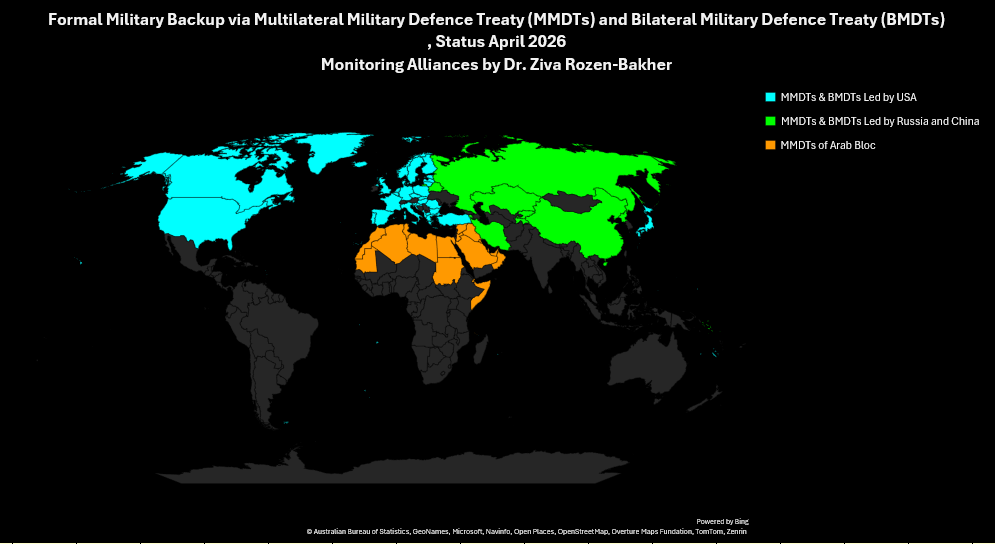
MMDTs and BMDTs of Superpowers and Bloc by Average of 2025 GSR
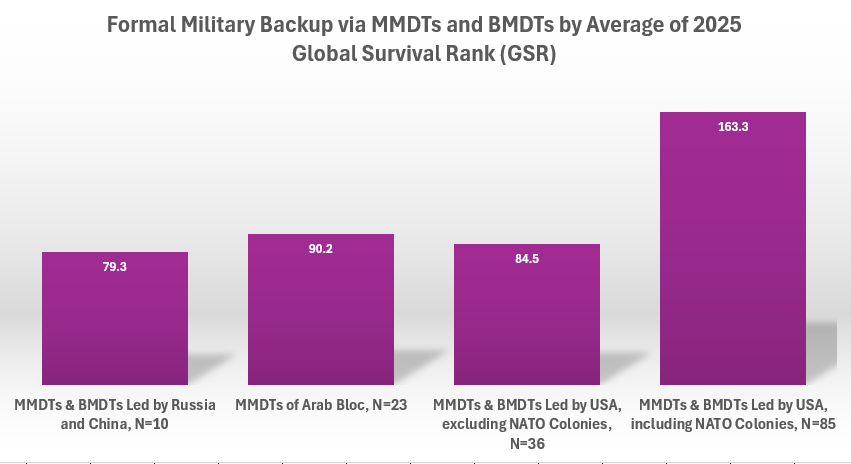
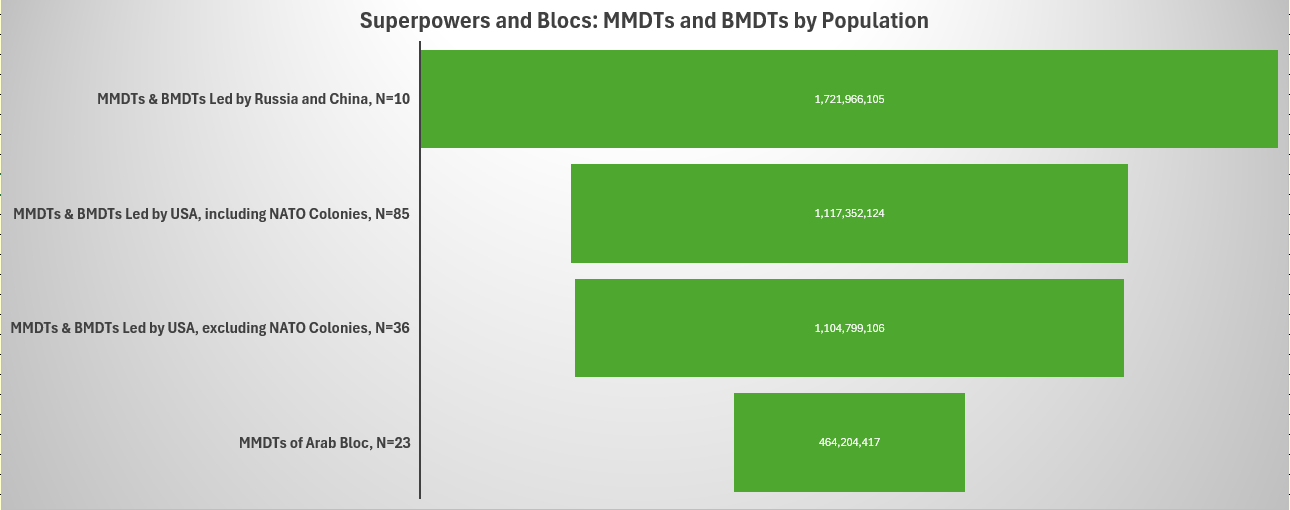
Chart of Superpowers and Blocs: MMDTs and BMDTs by Total Population
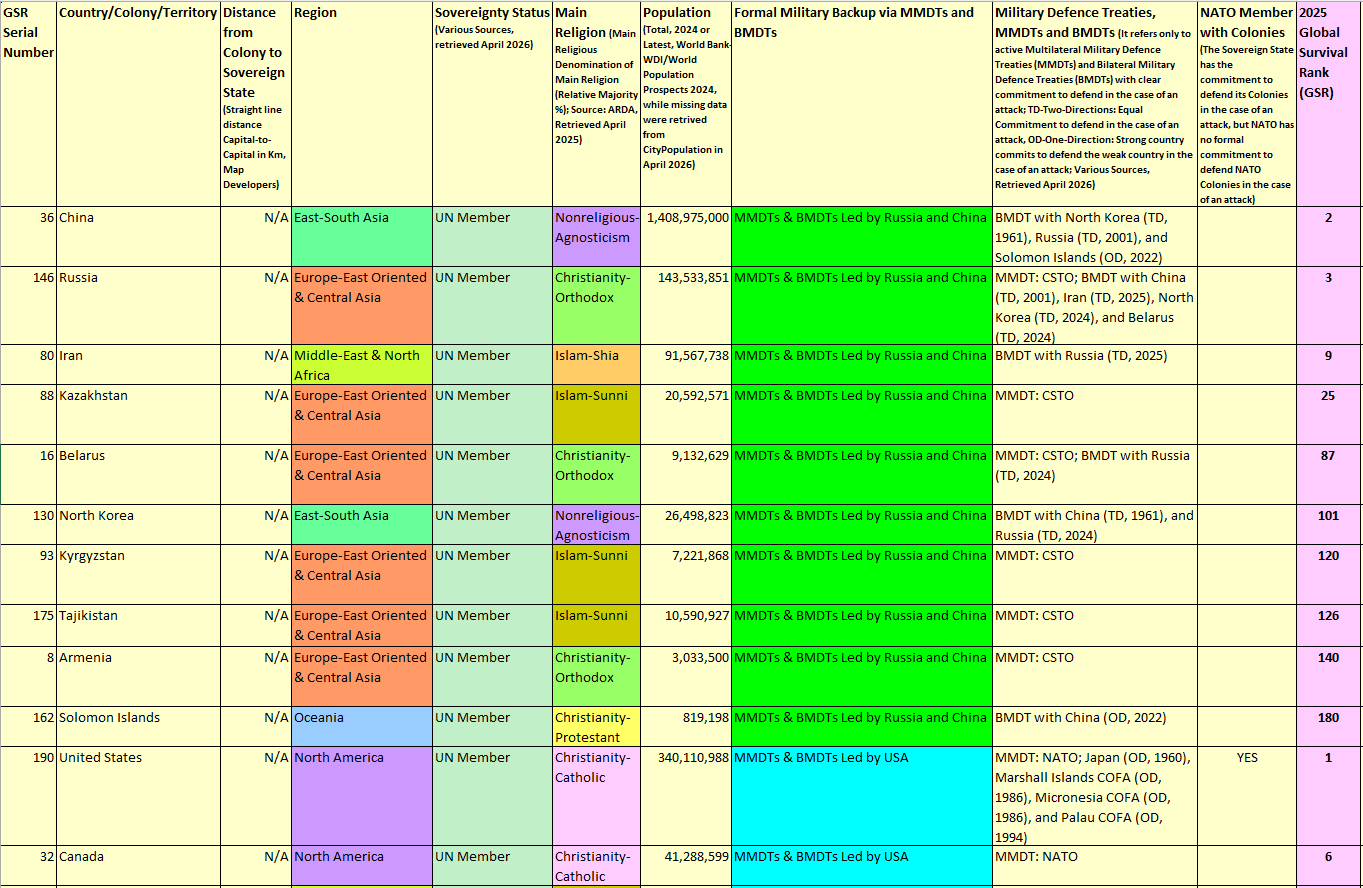
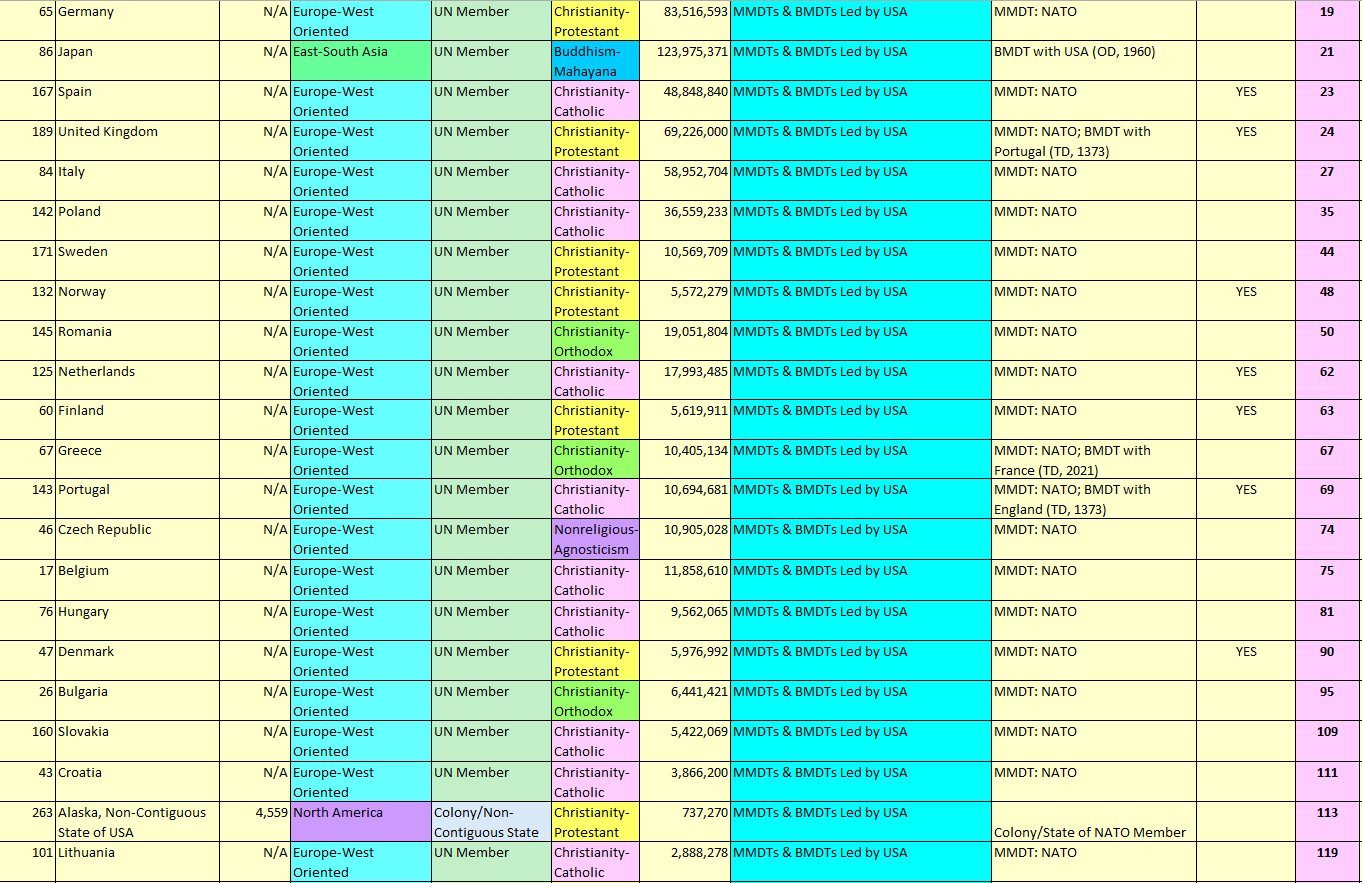
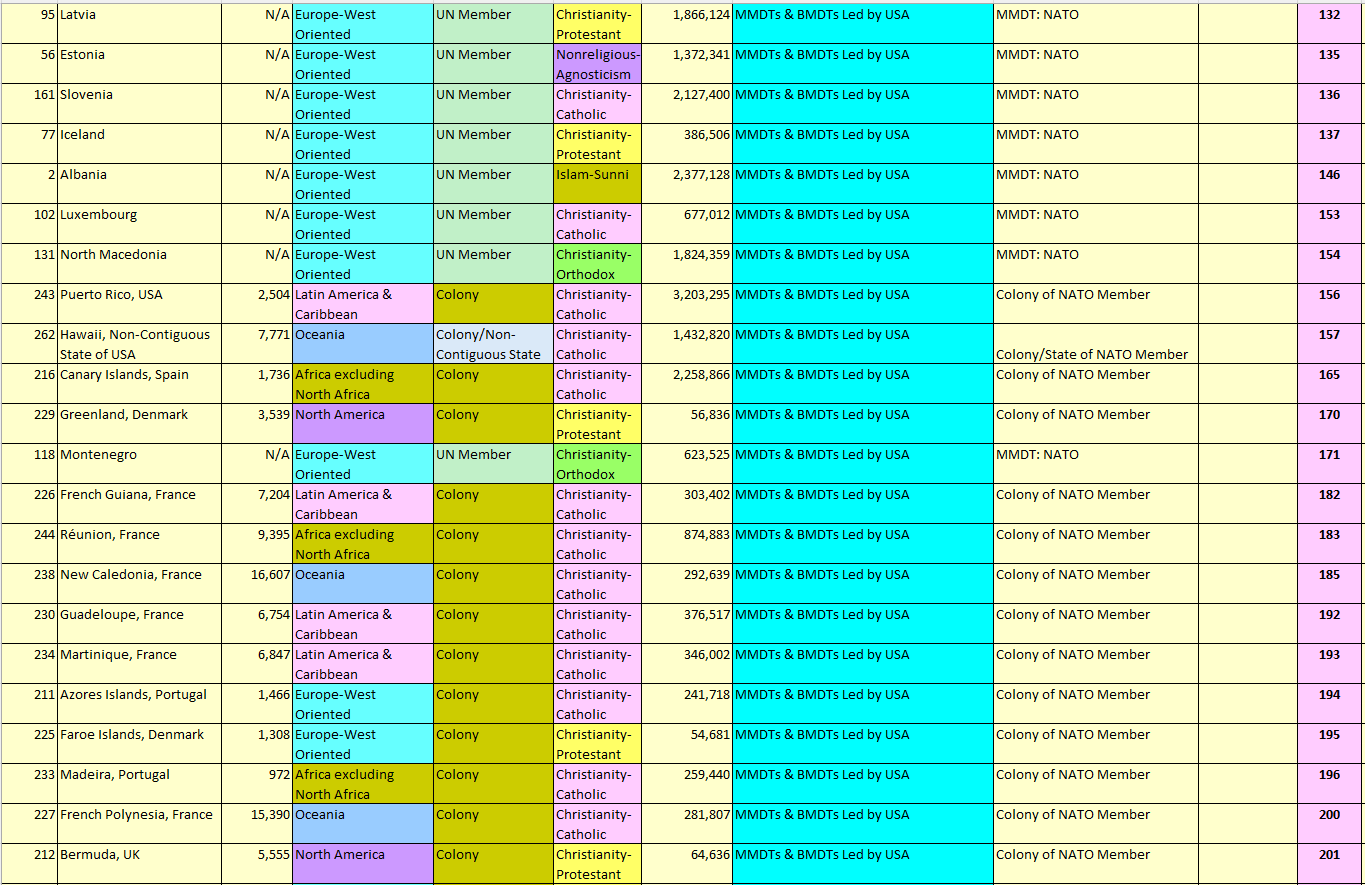
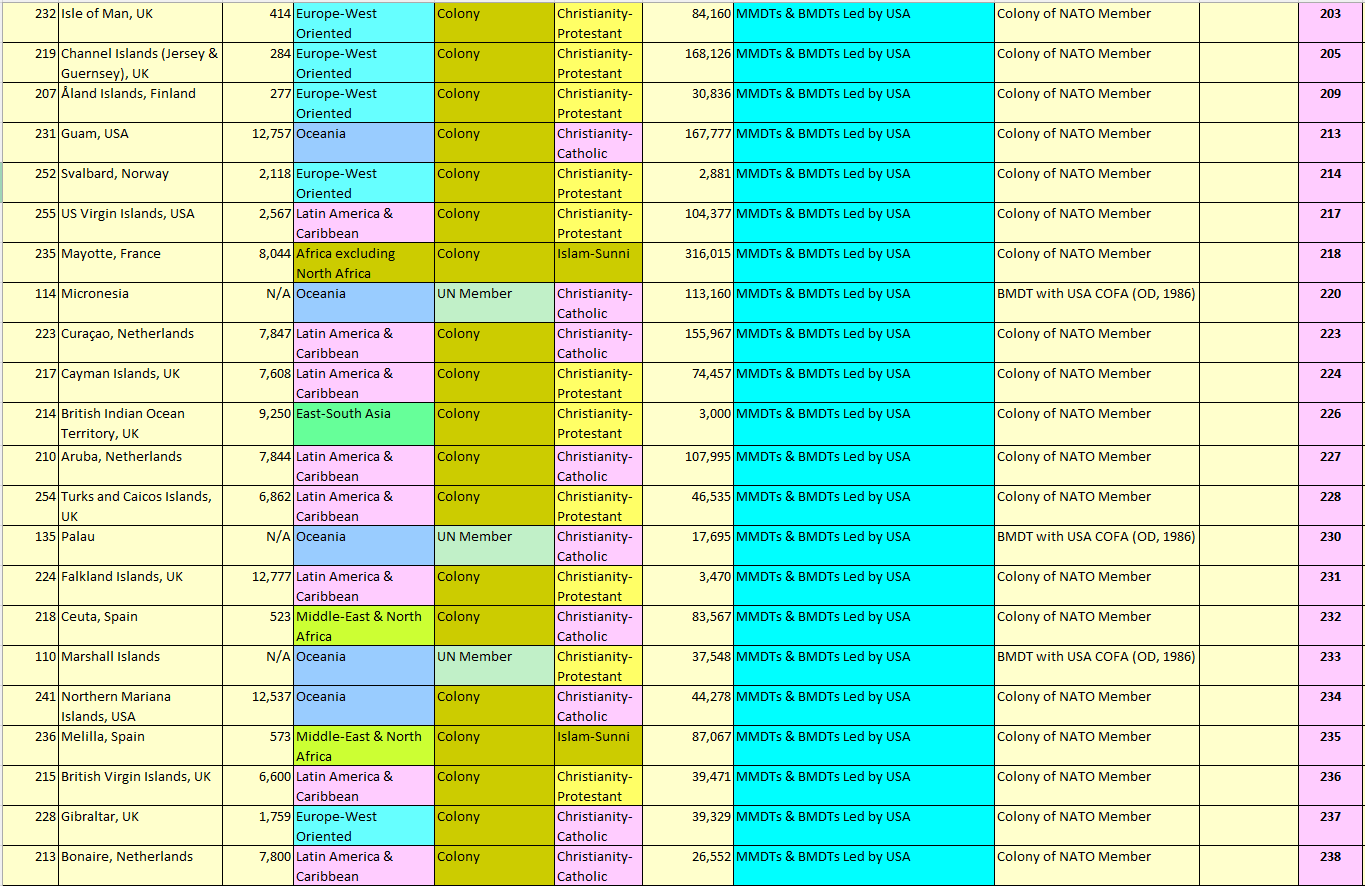
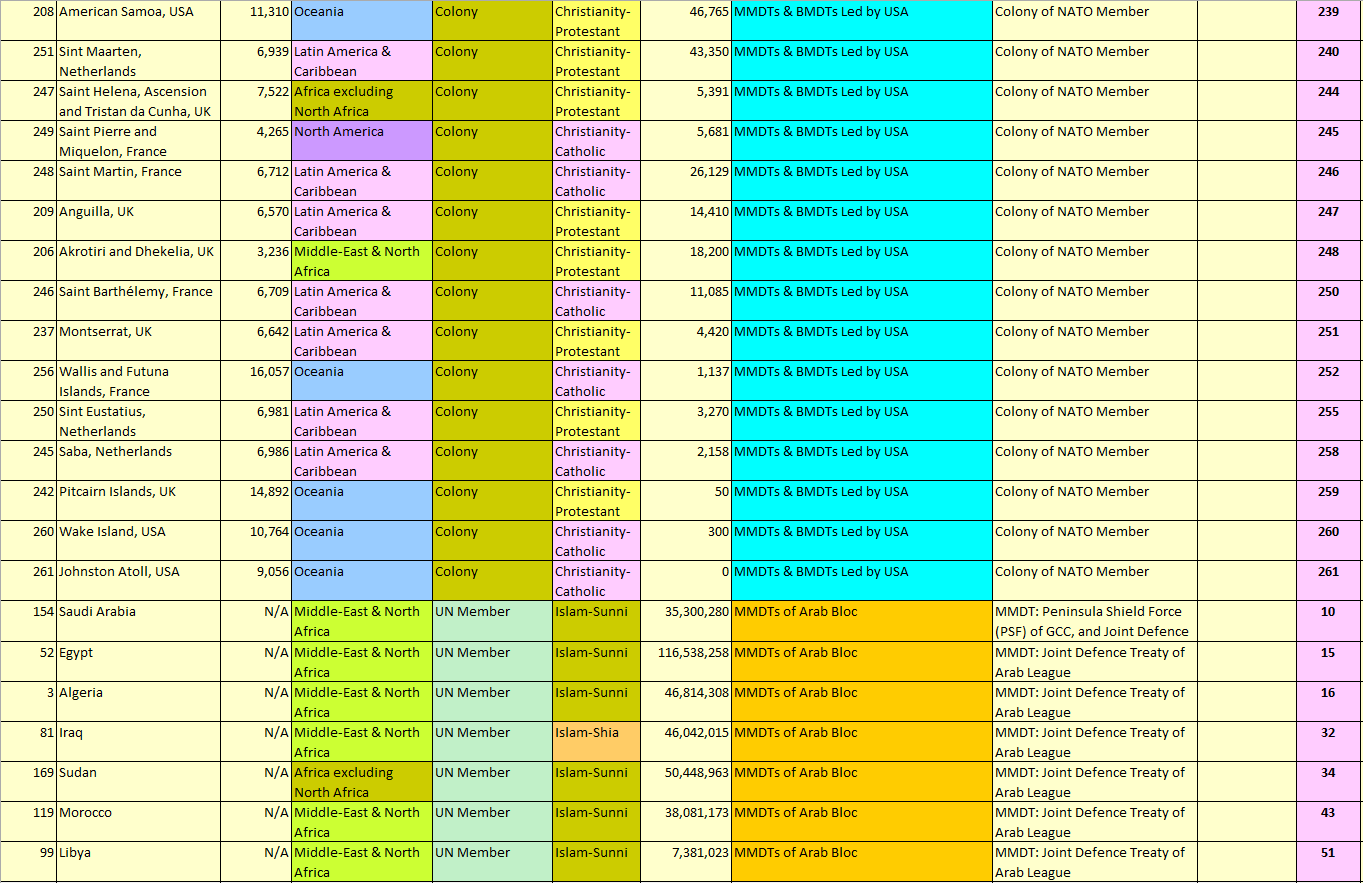
List of MMDTs and BMDTs by Superpowers and Blocs, sorted by 2025 GSR

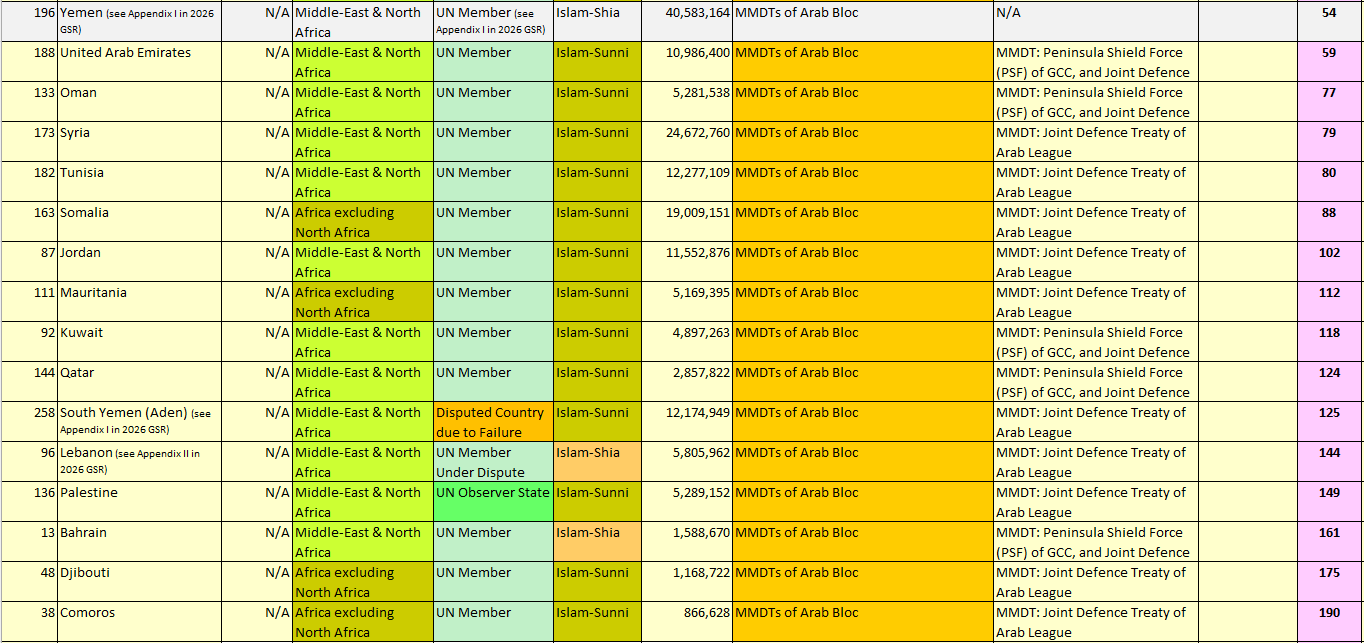
Mutual Defence Agreement (SMDA) of Saudi Arabia and Pakistan. In September 2025, Saudi Arabia and Pakistan signed a Strategic Mutual Defence Agreement (SMDA) that, according to the news, should be considered a BMDT, still, keep in mind that Saudi Arabia and Pakistan did not publish the content of the defence pact, so it is difficult to determine clearly if it is a BMDT or not. Importantly, when Iran attacked the Saudi Arabia territory following the USA-Israel attack against Iran, Pakistan declared in the news that Pakistan is not going to join the war against Iran to defend Saudi arabia as expected from the BMDT, because of the fear that it will lead to political instability in Pakistan, namely Pakistan has around 40-50 million Shia-Muslims that are in favour of Iran and oppose any joining of war against Iran. In light of the above, currently, the defence pact between Saudi Arabia and Pakistan is not included in the list of BMDTs above.
MMDTs and BMDTs Led by Russia and China by 2025 Global Survival Rank (GSR)
Section E19. CSTO - Multilateral Military Defence Treaty (MMDT): Collective Security Treaty Organization (CSTO), 2025 Global Survival Rank (GSR) by Dr. Ziva Rozen-Bakher https://www.rozen-bakher.com/gsr/2025/e/csto
Section E36. BMDT - Bilateral Military Defence Treaty (BMDT), 2025 Global Survival Rank (GSR) by Dr. Ziva Rozen-Bakher https://www.rozen-bakher.com/gsr/2025/e/bmdt
Section F2. Comparison of Bilateral Military Defence Treaty (BMDT), 2025 Global Survival Rank (GSR) by Dr. Ziva Rozen-Bakher https://www.rozen-bakher.com/gsr/2025/f/comparison-bmtd
Section F5. Comparison of Superpowers/ Permanent Members of UNSC: Military Backup and Military Risk, 2025 Global Survival Rank (GSR) by Dr. Ziva Rozen-Bakher https://www.rozen-bakher.com/gsr/2025/f/comparison-superpowers
or Relevant Items From the Research Projects of Dr. Ziva Rozen-Bakher - Military Alliances Led by Russia and China
Rozen-Bakher, Z., The CIA’s Illusion about Restoring the Iranian Autocratic Monarchy through Reza Pahlavi, the Son of the late Shah of Iran, Risks Timeline by Dr. Ziva Rozen-Bakher, 08 January 2026, https://www.rozen-bakher.com/timeline-risks/12/01/2026/0538
Rozen-Bakher, Z., Will Russia and China Form Counter-NATO? , Risks Timeline by Dr. Ziva Rozen-Bakher, 30 December 2022, https://www.rozen-bakher.com/timeline-risks/30/12/2022/1531
Rozen-Bakher, Z., Why Russia and China are wooed after Iran?: Military Capabilities of Iran , Risks Timeline by Dr. Ziva Rozen-Bakher, 09 December 2022, https://www.rozen-bakher.com/timeline-risks/09/12/2022/1826
Section E27. Counter-NATO led by Russia-China, 2024 Global Survival Rank (GSR) by Dr. Ziva Rozen-Bakher, https://www.rozen-bakher.com/gsr/2024/e/27
Rozen-Bakher, Z., ‘Merger of Allies’ of Russia-China Coalition , Risks Timeline by Dr. Ziva Rozen-Bakher, 13 March 2023, https://www.rozen-bakher.com/timeline-risks/13/03/2023/1534
Rozen-Bakher, Z., North Korea: The ‘Bad Boy’ of China , Risks Timeline by Dr. Ziva Rozen-Bakher, 18 September 2022, https://www.rozen-bakher.com/timeline-risks/18/09/2022/0729
Rozen-Bakher, Z., North Korea - Nukes Exporter? , Monitoring Risks by Dr. Ziva Rozen-Bakher, 5 February 2022, https://www.rozen-bakher.com/monitoring-risks/05/02/2022
Rozen-Bakher, Z., Sanctions against Iran and Shanghai Cooperation Organisation (SCO), Monitoring Risks by Dr. Ziva Rozen-Bakher, 3 February 2022, https://www.rozen-bakher.com/monitoring-risks/03/02/2022
Section E. Results, 2024 Global Survival Rank (GSR) by Dr. Ziva Rozen-Bakher, https://www.rozen-bakher.com/gsr/2024/e/results
Section E19. Russia's Multilateral Military Defence Treaty (MMDT) - Collective Security Treaty Organization (CSTO) and Russia’s BMDT, 2024 Global Survival Rank by Dr. Ziva Rozen-Bakher, https://www.rozen-bakher.com/gsr/2024/e/19
Section E20. Multilateral Alliance: Gulf Cooperation Council and its Peninsula Shield Force, 2024 Global Survival Rank by Dr. Ziva Rozen-Bakher, https://www.rozen-bakher.com/gsr/2024/e/20
Section E21. Multilateral Alliance: Arab League and its Arab Joint Security Pact, 2024 Global Survival Rank (GSR) by Dr. Ziva Rozen-Bakher, https://www.rozen-bakher.com/gsr/2024/e/21
Section E22. Bilateral Military Defence Treaties (BMDTs): China versus USA, 2024 Global Survival Rank (GSR) by Dr. Ziva Rozen-Bakher, https://www.rozen-bakher.com/gsr/2024/e/22
Section E23. Multilateral Alliance: Commonwealth of Independent States (CIS), 2024 Global Survival Rank (GSR) by Dr. Ziva Rozen-Bakher, https://www.rozen-bakher.com/gsr/2024/e/23
Section E24. Multilateral Alliance: Shanghai Cooperation Organisation (SCO), 2024 Global Survival Rank (GSR) by Dr. Ziva Rozen-Bakher, https://www.rozen-bakher.com/gsr/2024/e/24
Section E25. Multilateral Alliance: BRICS, 2024 Global Survival Rank (GSR) by Dr. Ziva Rozen-Bakher, https://www.rozen-bakher.com/gsr/2024/e/25
Section E27. Counter-NATO led by Russia-China, 2024 Global Survival Rank (GSR) by Dr. Ziva Rozen-Bakher, https://www.rozen-bakher.com/gsr/2024/e/27
Section E33. Muslim-Arab Bloc: OIC, Arab League, OPEC and GCC, 2024 Global Survival Rank (GSR) by Dr. Ziva Rozen-Bakher, https://www.rozen-bakher.com/gsr/2024/e/33
Military Alliances Led by Russia and China by the Blog on Foreign Direct Investment (FDI) and International Trade by Dr. Ziva Rozen-Bakher
Rozen-Bakher, Z. Blog on Foreign Direct Investment (FDI) and International Trade by Dr. Ziva Rozen-Bakher by Alphabetical Order https://www.rozen-bakher.com/search-blog-1
The copy of this section was carried out under the cyber of ICCG
Rozen-Bakher, Z. , Armenia, Blog on Foreign Direct Investment (FDI) and International Trade by Dr. Ziva Rozen-Bakher, 30 July 2023, https://www.rozen-bakher.com/blog/30072023/armenia
Rozen-Bakher, Z. , Belarus, Blog on Foreign Direct Investment (FDI) and International Trade by Dr. Ziva Rozen-Bakher, 19 May 2022, https://www.rozen-bakher.com/blog/2022/05/19/belarus
Rozen-Bakher, Z. , China, Blog on Foreign Direct Investment (FDI) and International Trade by Dr. Ziva Rozen-Bakher, 06 May 2022, https://www.rozen-bakher.com/blog/2022/05/06/china
Rozen-Bakher, Z. , Iran, Blog on Foreign Direct Investment (FDI) and International Trade by Dr. Ziva Rozen-Bakher, 27 May 2021, https://www.rozen-bakher.com/blog/2021/05/27/iran
Rozen-Bakher, Z. , Kazakhstan, Blog on Foreign Direct Investment (FDI) and International Trade by Dr. Ziva Rozen-Bakher, 26 August 2022, https://www.rozen-bakher.com/blog/2022/08/26/kazakhstan
Rozen-Bakher, Z. , Kyrgyzstan, Blog on Foreign Direct Investment (FDI) and International Trade by Dr. Ziva Rozen-Bakher, 24 February 2025, https://www.rozen-bakher.com/blog/24022025/kyrgyzstan
Rozen-Bakher, Z. , North Korea, Blog on Foreign Direct Investment (FDI) and International Trade by Dr. Ziva Rozen-Bakher, 11 April 2022, https://www.rozen-bakher.com/blog/2022/04/11/north-korea
Rozen-Bakher, Z. , Russia, Blog on Foreign Direct Investment (FDI) and International Trade by Dr. Ziva Rozen-Bakher, 01 April 2021, https://www.rozen-bakher.com/blog/01042021/russia
Rozen-Bakher, Z. , Solomon Islands, Blog on Foreign Direct Investment (FDI) and International Trade by Dr. Ziva Rozen-Bakher, 12 August 2024, https://www.rozen-bakher.com/blog/12082024/solomon-islands
Rozen-Bakher, Z. , Tajikistan, Blog on Foreign Direct Investment (FDI) and International Trade by Dr. Ziva Rozen-Bakher, 12 August 2021, https://www.rozen-bakher.com/blog/2021/08/12/tajikistan
From Scientific Literature - Research Papers and Research Books - BMDTs Led by Russia and China
For MMDTs Led by Russia and China, Please see Monitoring Alliances by Dr. Ziva Rozen-Bakher
North Korea's De Facto Alliance with Russia: The Nuclear Ramifications Park, H. R. (2025). North Korea's De Facto Alliance with Russia: The Nuclear Ramifications. asia policy, 20(3), 117-144.
Strategic Boundaries and Limitations of Iran-Russia Partnership Gergiieva, V., & Herrera, M. (2025). Strategic Boundaries and Limitations of Iran-Russia Partnership. Istituto Affari Internazionali (IAI).
Israel's 12-day war on Iran and the Russian fighter jet exports: A geopolitical analysis Eslami, M., & Akbarzadeh, S. (2025). Israel’s 12-day war on Iran and the Russian fighter jet exports: A geopolitical analysis. Mediterranean Politics, 1-13.
The Russia–North Korea Strategic Partnership and Authoritarian Alignment: Implications for the East Asian Security Order Yilmaz, S., & Kim, D. H. (2025). The Russia–North Korea Strategic Partnership and Authoritarian Alignment: Implications for the East Asian Security Order. Issues & Studies, 61(03), 2550011.
Between self-reliance and pragmatic interests: the impact of North Korea's troop deployment to Ukraine on its people Hwang, J. T., & Lee, S. (2025). Between self-reliance and pragmatic interests: the impact of North Korea’s troop deployment to Ukraine on its people. Australian Journal of International Affairs, 79(6), 1017-1025.
Russia, China, and North Korea Strategic Defense Partnership Naumenko, A. S., & Saltanov, S. D. (2024). Russia, China, and North Korea Strategic Defense Partnership. RUDN Journal of Political Science, 26(1), 107-120.
Investigating the Consequences of Iran's Defense-Security Cooperation and Russia in Ukraine Crisis (2022) Nikunahad, A., Emadi, S. R., & Biuck, M. (2024). Investigating the Consequences of Iran's Defense-Security Cooperation and Russia in Ukraine Crisis (2022). Crisis Studies of the Islamic World, 11(3), 65-92.
Redefining alliances: Exploring the emergence of the China-Russia military axis Kurylo, B. (2024). Redefining alliances: Exploring the emergence of the China-Russia military axis. Comparative Strategy, 43(6), 595-628.
Russia–China Strategic Alignment: Are They Headed Towards a Military Alliance? Kumar, R. (2024). Russia–China Strategic Alignment: Are They Headed Towards a Military Alliance?. China Report, 60(2), 129-147.
From Shaheen-II to China-Pakistan Economic Corridor: Pakistan-China Military and Economic Relations (2013-2023) At A Glance Ishaq, Z., Khan, A. B., & Rafeeq, R. (2024). From Shaheen-II to China-Pakistan Economic Corridor: Pakistan-China Military and Economic Relations (2013-2023) At A Glance. Journal of Asian Development Studies, 13(2), 1033-1044.
Analysing Comprehensive Strategic Partnership between China and Serbia: Political, Economic, and Military-Technical Relations Stekić, N. (2024). Analysing Comprehensive Strategic Partnership between China and Serbia: Political, Economic, and Military-Technical Relations. In Routledge Handbook of Chinese and Eurasian International Relations (pp. 214-227). Routledge.
Strategic reality check: the current state of Russia–China defence cooperation and the prospects of a deepening 'near alliance' Muraviev, A. (2021). Strategic reality check: the current state of Russia–China defence cooperation and the prospects of a deepening ‘near alliance’. Australian Journal of Defence and Strategic Studies, 3(1), 27-48.
Competition with China and US defence strategy: from net assessment to competitive strategies Simón, L., & Ernst, M. (2023). Competition with China and US defence strategy: from net assessment to competitive strategies. Defence Studies, 23(3), 359-380.
India-Russia defence co-operation Bakshi, J. (2006). India-Russia defence co-operation. Strategic Analysis, 30(2), 449-466.
From Documentaries and Inside TV News - BMTDs Led by Russia and China
For MMDTs Led by Russia and China, Please see Monitoring Alliances by Dr. Ziva Rozen-Bakher