https://www.rozen-bakher.com/monitoring-risks/07/07/2026
Published Date: 12 November 2026
COPYRIGHT ©2022-2026 ZIVA ROZEN-BAKHER ALL RIGHTS RESERVED
Rozen-Bakher, Z., Are the ‘Houthis‘ - Ansar Allah (Supporters of God) Rebels, or Has Saudi Arabia Intervened Militarily in Yemen—including Installing ‘Riyadh-Government in Aden‘—in order to Control Yemen?, Monitoring Risks by Dr. Ziva Rozen-Bakher, 07 July 2026, https://www.rozen-bakher.com/monitoring-risks/07/07/2024
Monitoring Risks by Dr. Ziva Rozen-Bakher
Analysing in-Depth Security & Political Risks and Economic & Strategic Risks
Rozen-Bakher, Z. Monitoring Risks by Dr. Ziva Rozen-Bakher https://www.rozen-bakher.com/monitoring-risks-1

Dr. Ziva Rozen-Bakher
Researcher in International Relations and Foreign Policy with a Focus on Risks for Foreign Direct Investment (FDI) and International Trade: International Security, Political, and Economic Risks
Are the ‘Houthis‘ - Ansar Allah (Supporters of God) Rebels, or Has Saudi Arabia Intervened Militarily in Yemen—including Installing ‘Riyadh-Government in Aden‘—in order to Control Yemen?
Houthis or Ansar Allah (Supporters of God) or North Yemenis?The West used to call them Houthis on the name of their religious leader, Sayyid Abdul-Malik Badr al-Din al-Houthi, while they call themselves Ansar Allah (Supporters of God), and from the geopolitical perspective, they are North Yemenis. 
List of Contents
Are the ‘Houthis‘ - Ansar Allah (Supporters of God) Rebels, or Has Saudi Arabia Intervened Militarily in Yemen—including Installing ‘Riyadh-Government in Aden‘—in order to Control Yemen?
Section 1. Introduction
Section 2. Two Yemeni States Before the Unification: Timeline of North Yemen (Sanaa) versus South Yemen (Aden)
Section 3. The Saudi Conquest of the Yemeni provinces—Jizan, Asir and Najran—: Northern Kingdom of Yemen was Forced to Cede them to Saudi Arabia under the Treaty of Taif, 1934
Section 4. The Saudi Military Intervention in the North Yemen Revolution War to Prevent the Regime Transformation in North Yemen from Monarchy into Republic: The War between Saudi-Backed Yemeni Royalist Forces against the Yemeni Republican Forces, 1962-1970
Section 5. The Unification of Yemen between North Yemen (Sanaa) and South Yemen (Aden): Does the Unification of Yemen have Prospects for Success?, 1990
Section 6. Yemen in the First Years After the Unification Under Saudi Interference: Economic Scheme and Political Scheme, 1990-1993
Section 7. The Yemeni Civil War in 1994: The Refusal of the Yemeni Socialist Party (YSP) to Accept the Democratic Results of the First Yemeni Parliamentary Election after the Unification - The Prelude for ‘Riyadh-Government in Aden‘, 1993-1994
Section 8. The ‘Democratic Years‘ in Yemen After the Unification: Yemen Under the Ruling Northern Political Party, General People's Congress (GPS), 1994-2011
Section 9. The Arab Spring as a Pretext for the Saudi Strategy for a Regime Transformation: Making a ‘Legitimate Leader‘ to a ‘Non-Legitimate Leader‘
Section 10. The Saudi Plan - ‘GCC Initiative‘ - For Regime Transformation in Yemen: Forcing the Resignation of the Yemeni President Saleh in order to Install instead the ‘Riyadh-Government in Aden‘ by Saudi Forces, 2011-2015
Section 11. The Saudi Military Intervention in Yemen: Controlling South Yemen by Saudi Forces and Saudi Mercenaries to Maintain by Force the ‘Riyadh-Government in Aden‘, while Trying to Conquest North Yemen by Saudi Bombarding, Blockade, and Starvation – Is Saudi Arabia Committed Genocide in North Yemen?, 2015-2022
Section 12. The Peace Deal between North Yemen and Saudi Arabia, 2022-2026
Section 13. The Liberation War of North Yemen against the Saudi Forces and Saudi Mercenaries that Control Yemen, 2026-Current
Section 14. Summary
Section 15. Citations
Section 16. Recommended Reading
Section 1. Introduction
Since 2015, each day, the West media has told us that the Houthis are the Bad Guys, Rebels, while the Saudis are the Good Guys that save Yemen from the Bad Guys, the Houthis. During this bloody decade, too many Northern Yemenis dead from bombarding, famine and illness due to the Saudi blockade and starvation as a weapon of war, but still the West did not condemn Saudi Arabia and it even help them to fight against the Bad Guys, the Houthis. During this decade, any general election did not took place in Yemen or even in South Yemen that was under the control of Saudi forces to protect the “Yemeni Internationally Recognized Government” that sometimes operated from Aden and sometimes operated from hotels in Riyadh. During this decade, only the West recognized the “Yemeni Internationally Recognized Government”, while the population in North Yemen - Houthis - did not recognize the ‘Riyadh-Government in Aden‘ nor most of the population of South Yemen that was even involved in endless civil war against the so call the “Yemeni Internationally Recognized Government” that was needed again and again to flee to Riyadh due to the ongoing civil war in South Yemen. Thus, clearly, since the Saudi military intervention in Yemen, the democracy in Yemen cease from exists, while South Yemen more looks like a Colony of Saudi Arabia over as an Independent country, regardless of the human suffering in North Yemen and the endless bloody civil war in South Yemen.
Nevertheless, if we analyse the dispute between North Yemen and Saudi Arabia from a historical perspective, then questions arise about labeling Houthis as the Bad Guys, while labeling the Saudis as the Good Guys, so this paper used a critical analysis to understand if indeed the ‘Houthis‘ - Ansar Allah (Supporters of God) are Rebels, or if Saudi Arabia intervenes militarily in Yemen—including installing ‘Riyadh-Government in Aden‘—in order to control Yemen. To answer this question, the paper runs through a “Time Tunnel” - Past, Present, and Future - to reveal if Saudi Arabia plans intentionally the regime transformation in Yemen in order to control Yemen through the ‘Riyadh-Government in Aden‘ as part of its long-decades strategy towards Yemen.
Section 2. Two Yemeni States Before the Unification: North Yemen (Sanaa) versus South Yemen (Aden)
North Yemen (Sanaa) (Cite 1, Cite 2, Cite 3) and South Yemen (Aden) (Cite 4, Cite 5, Cite 6) were both independent countries and UN members before the unification of Yemen in 1990, as shown in Map 1 and in the Timeline below. However, North Yemen (Sanaa) had the bigger population compared to South Yemen (Aden), namely 7,160,981 million vs. 2,585,484 million, as shown in Map 2 that present the Administrative Divisions of Yemen and in Table 1. that presents the total population of North Yemen vs. South Yemen by Administrative Divisions before the unification. Thereby, North Yemen (Sanaa) had 73.5% of total the Yemen population before the unification, while South Yemen (Aden) had only 26.5%. Importantly, North Yemen (Sanaa) had more economic and political stability (Cite 7) compared to South Yemen (Aden) over its history (Cite 23), while South Yemen (Aden) suffered from lack of political integration and lack of political identity over centuries (Cite 8), as shown in Video 1 that presents the Yemen History Timeline. More specifically, North Yemen (Sanaa) was already an independent country in 1918 and a UN Member already in 1947, while South Yemen (Aden) was a British Colony until 1967 (Cite 9), yet without integral territory over the whole territory of South Yemen. In 1967, South Yemen became for the first time an independent country and a UN member as a Communist State under the People's Republic of Southern Yemen (PRSY) (Cite 4 and Cite 39), but this regime survived only three years until 1970 when the People's Democratic Republic of Yemen (PDRY) was established instead, yet without economic success.
This historical background may explain why South Yemen (Aden) functions, to this day, as a de facto colony of Saudi Arabia, namely South Yemen was used to be dependent on foreign aid, whether as a British colony or as a communist state, regardless of the lack of political integration among its population, which led to repeated civil wars in South Yemen. In contrast, North Yemen (Sana'a) has greater political integration among its tribes, despite having suffered—for many years—a harsh war, a blockade, and even starvation at the hands of Saudi Arabia due to their desire to live as an independent country, without being a colony of Saudi Arabia or being under the occupation of Saudi forces.
Timeline of South Yemen (Aden)
Until 1838. Part of Ottoman Empire
1838-1967. British Colony
1838-1967: Non-UN Member
1967-1970. People's Republic of Southern Yemen (PRSY) (Communist State)
1967-1970: UN member
People's Democratic Republic of Yemen (PDRY) (Aden), 1970-1990
1970-1990: UN member
1970-1990: Member of Arab League
1970-1990: Member of OIC - Organisation of Islamic Cooperation (OIC)
Timeline of North Yemen (Sanaa)
Pre-WWI. Part of Ottoman Empire
1918-1962. Northern Kingdom of Yemen
1918-1947: Non-UN Member
1947-1962: UN member
1945-1962: Member of Arab League
Yemen Arab Republic (YAR), 1962-1990
1962-1990: UN member
1962-1990: Member of Arab League
1969-1990: Member of OIC - Organisation of Islamic Cooperation (OIC)
Map 1. North Yemen (Sanaa) versus South Yemen (Aden) before the Unification of Yemen
Map 2. North Yemen (Sanaa) versus South Yemen (Aden) by Administrative Divisions
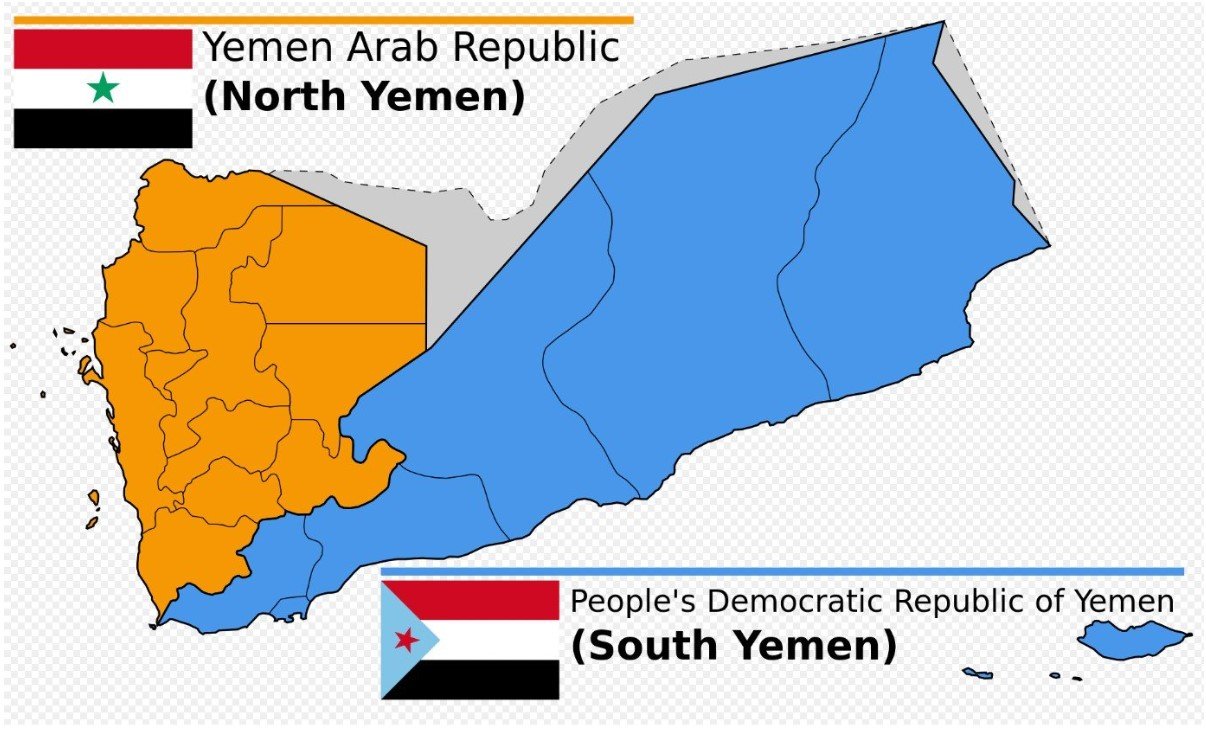
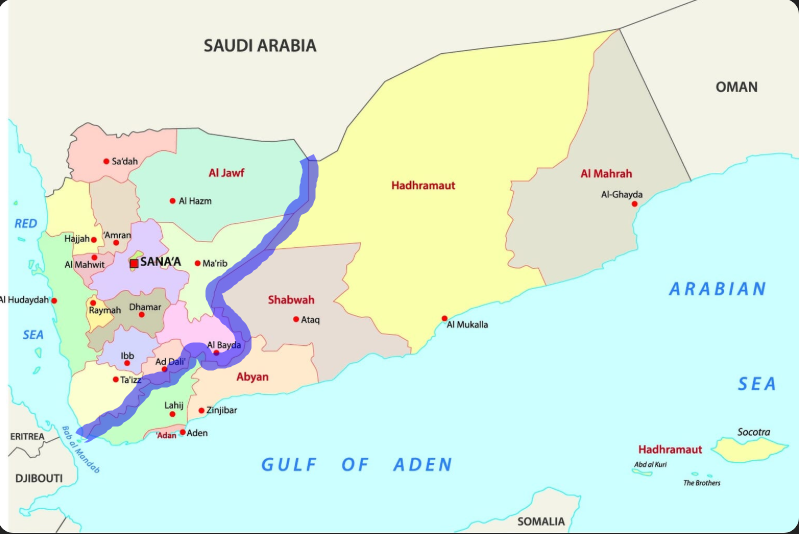
Table 1. Administrative Divisions of Yemen before the Unification by Population of North Yemen vs. South Yemen
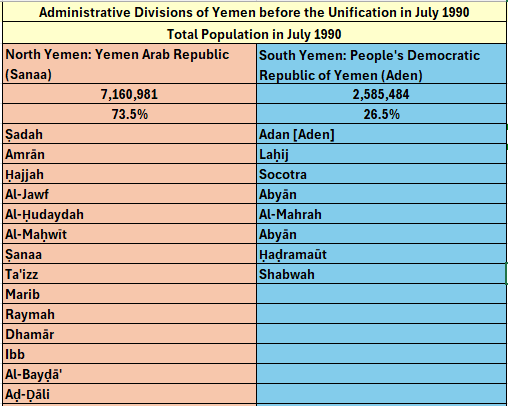
Source for Population: The World Factbook (1990)
Video 1. Yemen History Timeline
Section 3. The Saudi Conquest of the Yemeni provinces—Jizan, Asir and Najran—: Northern Kingdom of Yemen was Forced to Cede them to Saudi Arabia under the Treaty of Taif, 1934
Since mid-18 century until mid-20 century, the House of Saud was very busy with the project of ‘Greater Saudi Arabia‘ (Cite 10-Cite 12), namely creating huge Saudi territory by conquering maximum territories in the Arabia Peninsula from other states, kingdoms, emirates, sheikdoms, city-states, and tribes, as shown in Map 3 that present the territories that conquered by Saudi Arabia in the 20 century, which also include conquering some territories from the Northern Kingdom of Yemen. More specifically, Northern Kingdom of Yemen was established in 1918 after WWI, which was included the three Yemeni Northern Provinces: Jizan, Asir, and Najran, while Saudi Arabia was established in 1932 following the unprecedented conquering territories in the Arabia Peninsula. However, two years after its establishment, Saudi Arabia continued with its ‘Greater Saudi Arabia‘ project via the Saudi-Yemeni War in 1934 in order to get some territories from Yemen, resulting in forcing the Northern Kingdom of Yemen to cede to Saudi Arabia three Yemeni Provinces: Jizan, Asir, and Najran under the Treaty of Taif (Cite 13), as shown in Map 4 that presents these three former Yemeni provinces. Following that, the territory of the Northern Kingdom of Yemen was significantly reduced in 1934 under the Treaty of Taif, as shown in Map 4 and Map 5 that compare its territory before and after the Saudi conquest of the Yemeni territories.
Following the Saudi Conquest of the Yemeni provinces in 1934, Saudi Arabia and Yemen have border disputes, so before the Unification of Yemen, the Saudis succeeded in delaying serious border discussions with North Yemen/South Yemen due to the excuse that they do not know with whom to talk, but the Unification denied this ploy of Saudi Arabia (Cite 42). However, even after the unification, Saudi Arabia continued with this ploy by delaying the discussions with Yemen even, and eventually, only in the year 2000, Saudi Arabia “resolved” it with the ‘Riyadh-Government in Aden‘ under the Treaty of Jeddah (Cite 43 and Cite 44), namely Saudi Arabia de-facto instructed/forced the ‘Riyadh-Government in Aden‘ to agree that Yemen has no more claim regarding Jizan, Asir and Najran, which definitely is not the case from the viewpoint of North Yemen. Thereby, it can be argued that Saudi Arabia signed the Treaty of Jeddah with those who do not own these territories, because clearly, North Yemen or the Yemeni President Saleh would not have agreed to sign the Treaty of Jeddah, because until today, North Yemen has a claim regarding Jizan, Asir and Najran (Cite 45). Therefore, the dispute between Saudi Arabia and North Yemen on - Jizan, Asir and Najran - is still open de-facto, because North Yemen does not recognize the Treaty of Jeddah that was signed between Saudi Arabia and ‘Riyadh-Government in Aden‘.
Nevertheless, from a historical perspective, it can be argued that the Saudi ‘Military Project‘ in Yemen already began in 1934, when Saudi Arabia forced Yemen—through the use of Saudi military force—to cede three Yemeni provinces, which can be considered a prelude to the Saudi military intervention in Yemen in the years to come.
Map 3. Territories that Conquered by Saudi Arabia in the 20th Century
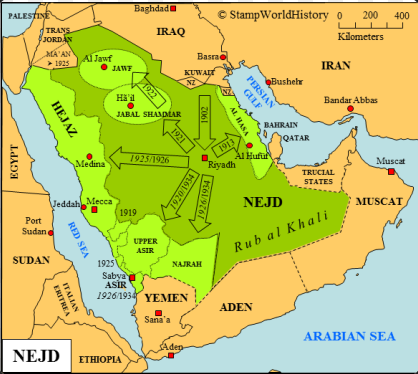
Map 4. The Three Yemeni Provinces - Jizan, Asir, and Najran - that the Northern Kingdom of Yemen Forced to Cede to Saudi Arabia under the Treaty of Taif Following the Saudi-Yemeni War in 1934
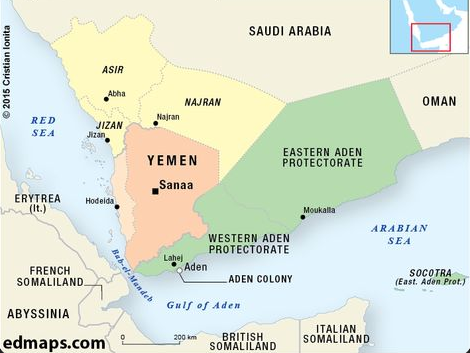
Map 5. Northern Kingdom of Yemen before the Saudi Conquest of the Yemeni Provinces - Jizan, Asir, and Najran, 1918-1934
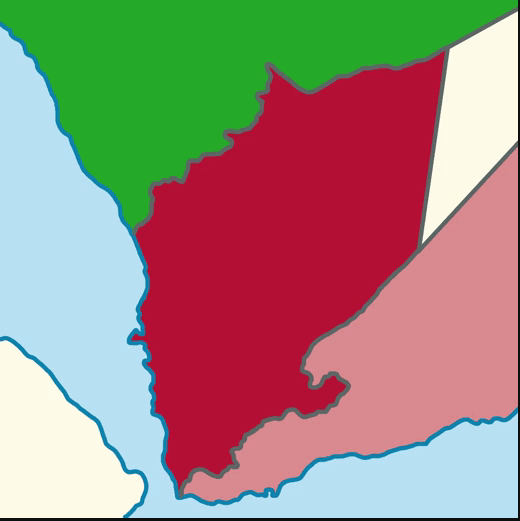
Map 6. Northern Kingdom of Yemen After being Forced to Cede - the Yemeni Provinces Jizan, Asir, and Najran - to Saudi Arabia under the Treaty of Taif, 1934
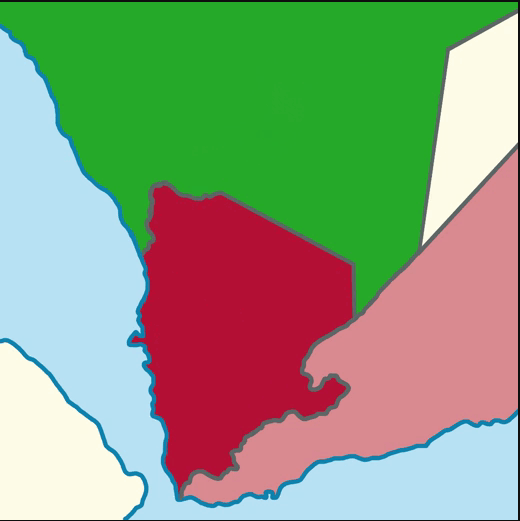
Section 4. The Saudi Military Intervention in the North Yemen Revolution War to Prevent the Regime Transformation in North Yemen from Monarchy into Republic: The War between Saudi-Backed Yemeni Royalist Forces against the Yemeni Republican Forces, 1962-1970
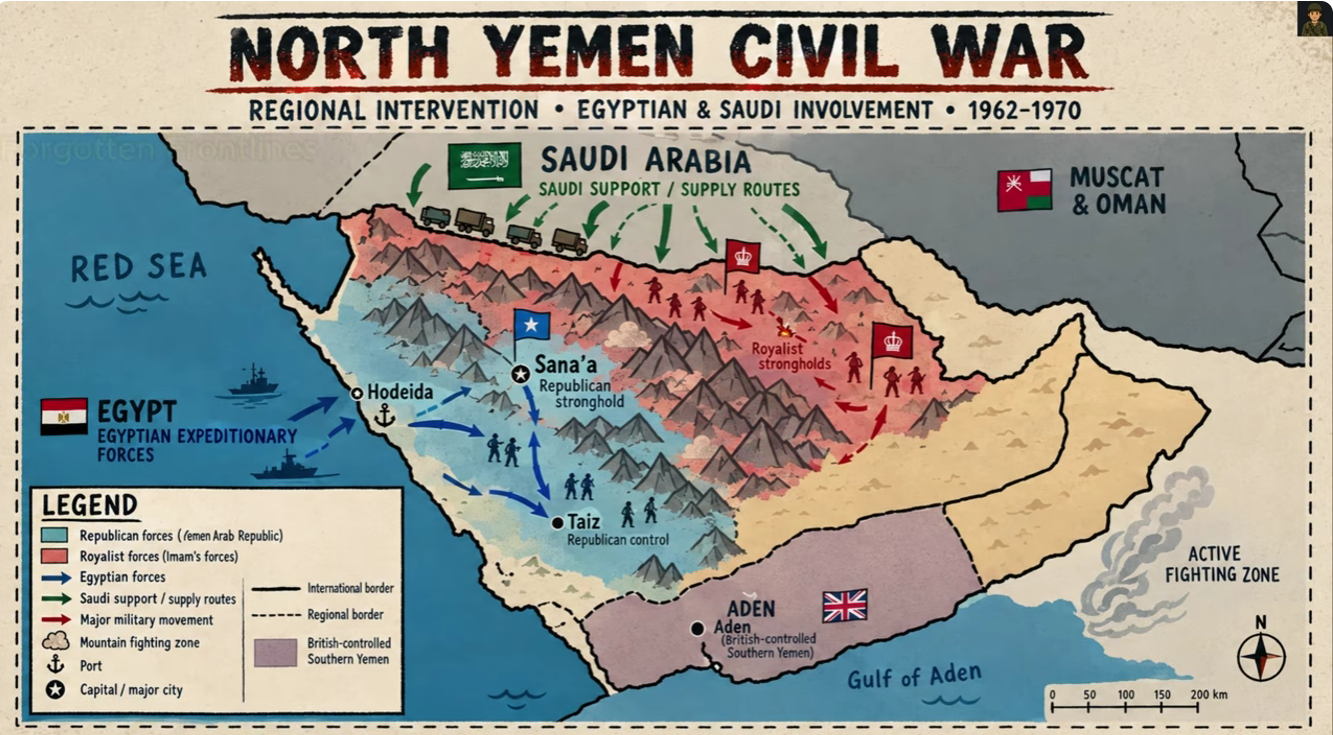
From a historical perspective, the Saudi military intervention in Yemen did not start in 2015, but already in the Yemeni Revolution war in 1962 when the Yemeni Northern people decided to replace the Absolute Monarchy of Kingdom of Northern Yemen with Democratic Republic of Yemen Arab Republic (YAR) (Cite 14 and Cite 15). During this period, countless of Monarchies around the world were replaced by Republics via Revolutions (Cite 16), yet without military intervention by foreign countries as done in the revolution in North Yemen. More specifically, Saudi Arabia not only militarily intervened in the Yemeni republic revolution, but it also run a war for over eight years against the Northern Yemeni Republican Forces in trying to prevent the fall of the Yemeni monarchy with countless casualties on each side (Cite 17), as shown in Map 3. that presents the North Yemen Revolution War between Saudi-Backed Yemeni Royalist Forces and Egypt-Backed Yemeni Republican Forces that last eight years from 1962-1970. During the revolution fight, Saudi Arabia fights side by side with the Yemeni monarchy forces in trying to prevent the regime transformation of Yemen from Absolute Monarchy into Republic, while Egypt provided military assistance to the Yemeni Republican Forces (Cite 18). However, in 1967, Egypt pulled out its forces from Yemen (Cite 19) due to the 1967 War with Israel, and despite it, the Saudi-Backed Yemeni Royalist Forces did not success to overcome the Yemeni Republican Forces until 1970 (Cite 17) when a settlement reached between Saudi Arabia and Yemen Arab Republic (YAR) (Cite 20). Thereby, after 8 years of fighting with significant casualties for both sides, eventually, Saudi Arabia recognized Yemen Arab Republic (YAR) (Cite 21).
Considering the above, it can be argued that the attempt of Saudi Arabia to control Yemen started in 1962 when North Yemen became a Republic, namely Saudi Arabia sees Republics as a threat to their monarchy, especially if they closed to their borders, so Saudi Arabia tried to block the regime transformation in Yemen from monarchy to republic through the War in 1962-1970 between the Saudi-Backed Yemeni Royalist Forces and the Yemeni Republican Forces, but without success. However, even after that, the main objective of Saudi Arabia was to keep Yemen divided by continually manipulated the tribal opposition to Sanaa for Saudi benefit (Cite 41), so the bitterness of this long war and its aftermath remains an obstacle for the future relationship between Saudi Arabia and North Yemen. Nevertheless, from the military perspective, the ability of the Northern Yemeni Forces to hold against the Saudi Forces was repeated itself not only in the Yemeni Revolution War in 1962-1970 but also in the war between them in 2015-2022 when a peace deal eventually was reached in 2022 due to the inability of Saudi Arabia to take control over North Yemen despite the Saudi mass bombarding, blockade and starvation against North Yemen. Even in the current war that erupted between them again in 2026, the Saudi Forces have no ability to get control over North Yemen, while Northern Yemeni Forces are on the process of liberating the whole Taiz District from the Saudi Forces, regardless of their ability to paralyze the Saudi airports with their missile attacks.
Map 7. The North Yemen Revolution War between Saudi-Backed Yemeni Royalist Forces and Egypt-Backed Yemeni Republican Forces, 1962-1970
Section 5. The Unification of Yemen between North Yemen (Sanaa) and South Yemen (Aden): Does the Unification of Yemen have Prospects for Success?, 1990
The South Yemeni civil war that erupted in 1986, which led to mass killing in South Yemen (Cite 22), paved the way to the Unification of Yemen (Cite 14) in order that the stronger country, North Yemen (Sanaa), will lead Yemen, with the aim of resolving the problems in South Yemen (Aden) (Cite 2). In other words, the South Yemen Civil War in 1986 led to the replacement of the leadership in South Yemen (Cite 2), which paved the way to the Unification of Yemen between the new leadership in South Yemen and the leadership in North Yemen. Following that, in May 1990, the Republic of Yemen was established based on the Unification between the Yemen Arab Republic (YAR) (Sanaa) and the People's Democratic Republic of Yemen (PDRY) (Aden) (Cite 24), with the hope that the Unification of Yemen will lead to more economic prosperity, including through joint oil exploration (Cite 25 and Cite 42). Importantly, based on the reality that North Yemen (Sanaa) is the stronger country with the bigger population, then it was defined that the leader of North Yemen will be the Head of State of the Republic of Yemen after the unification, while the leader of South Yemen will be the Head of Government (Cite 24).
However, the architects of the Unification of Yemen did not take into account the critical differences between North Yemen (Sanaa) and South Yemen (Aden) (Cite 25 and Cite 34), as follows:
Big Population in North Yemen vs. Small Population in South Yemen. In 1990, before the unification, the population in North Yemen was 7,160,981 million versus 2,585,484 million in South Yemen (see Table 1), so before the unification, North Yemen had 73.5% of the total Yemen population, while South Yemen had only 26.5% of the total Yemen population, which reflects the current situation. This difference in the population size between North Yemen and South Yemen is also reflected in the political arena in Yemen, namely the results of any election in Yemen always will give advantage to political parties from North Yemen over the political parties from South Yemen, as indeed was the outcome in any unified Yemeni Election that took place after the unification (See Tables 2-4).
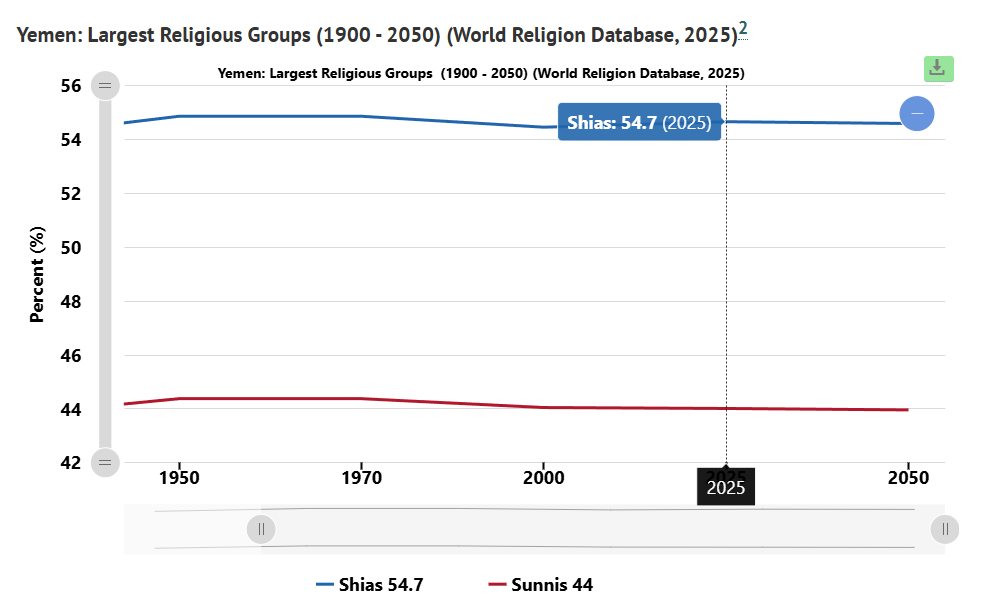
Shia Majority in North Yemen vs. Sunni Majority in South Yemen. The main religion in Yemen in 2025 was Shia with 54.7%, while Sunni had only 44.0%, yet the proportion of Sunnis in Yemen even decreased from 44.4% in 1950 to 44.0% in 2025, as shown in Chart 1 that presents the Religion in Yemen. However, North Yemen (Sanaa) has a Shia majority, while South Yemen (Aden) has a Sunni majority. Nevertheless, the population in North Yemen (Sanaa) is considered as one of the most religious populations among the Muslim countries, namely they practice the religious in a very strict way based on the Quran and the Sharia. However, the population in South Yemen (Aden) is more scholar one due to the Western influence when South Yemen (Aden) was a British Colony from 1838 until 1967. In other words, the religious leaders of North Yemen demand sharia for the whole country, while Saudi-backed Al-Islah demands secular state (Cite 41). Therefore, this Religious Difference between North Yemen (Sanaa) and South Yemen plays a significant role in any election because the population size in North Yemen is much bigger than in South Yemen. In other words, the results of any election in Yemen always will give advantage to the Shia political parties over the Sunni political parties, as indeed was the outcome in any unified Yemeni Election that took place after the unification (See Tables 2-4).
Independency in North Yemen vs. Dependency in South Yemen. The economy of North Yemen (Sana'a) always characterizes by economic independence (cite 7) compared to the economy of South Yemen (Aden) (Cite 23) that mainly relies on aid (Cite 26), whether during its time as a British colony or when it was a Communist State, so North Yemen (Sana'a) opposes any foreign interfering, especially by Saudi Arabia, while South Yemen (Aden) has no problem in becoming dependent on foreign aid, especially from Saudi Arabia (Cite 27).
Tribal Integration in North Yemen vs. Tribal Disintegration in South Yemen. North Yemen (Sanaa) always enjoys from social solidarity, tribal integration, and patriotism, which allows North Yemen (Sanaa) to handle external threats in an effective way (Cite 28). However, South Yemen (Aden) always suffer from internal conflicts among its tribes (Cite 29), which has led to repeated military conflicts and civil wars in South Yemen (Cite 26), whether before the unification of Yemen or after it, such as between “Riyadh-Government in Aden” and Southern Transitional Council (STC) (Cite 30). The Tribal disintegration in South Yemen comes to forth until today when Saudi Forces and Saudi Mercenaries need to fight against the Northern Yemeni Forces by its own because most the Southern tribes ignored the Saudi call for general mobilization (Cite 28 and Cite 29). Worse, when the army headquarter of “Riyadh-Government” sits in hotels in Riyadh instead of in Aden, then their call for general mobilization in South Yemen looks even ridicules when the governmental buildings in Aden are empty (Cite 29). That´s situation has led Saudi Arabia to allow Gangs to join the fight in Yemen as Saudi Mercenaries or worse to run the cities in Yemen under the Saudi control by Gangs (Cite 32), such as what happened in the city of Taiz over the last 12 years that run by Saudi Mercenaries in the style of Gangs (Cite 31), namely the Gangs used to loot shops, as shown in Video 2 and Video 3, and worse, the Gangs even takeover properties in Taiz and even done various serious crimes against the locals. Note, Taiz district including Taiz City were part of North Yemen before the unification (see Map 1 and Map 2). Thus, from the viewpoint of the locals in Taiz, Saudi forces and Saudi Mercenaries are like occupied forces, while they see the Northern Yemeni Forces as liberation forces (Cite 28 and Cite 33).
Chart 1. Religion in Yemen in 2025: Shia (54.7%) vs. Sunni (44.0%)
Source: ARDA
Video 2. Looting Shops in the City of Taiz by Saudi Mercenaries that act Like Gangs
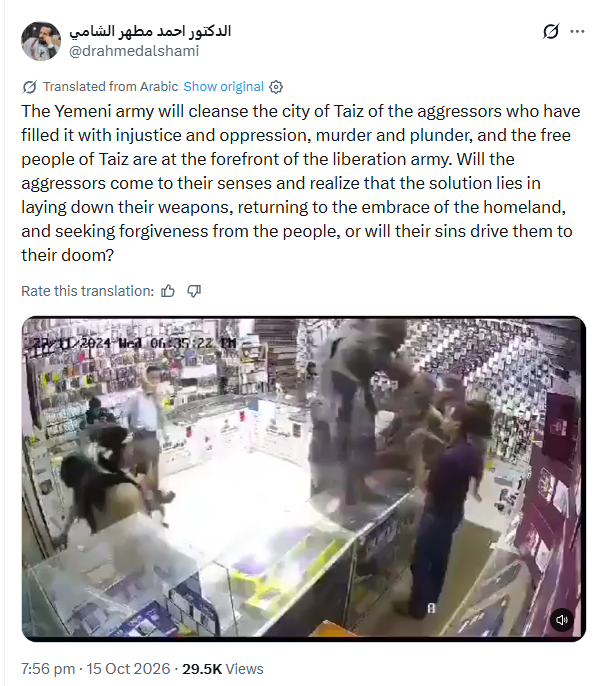
Source: https://x.com/drahmedalshami/status/2110807100851102076
The translation to English was based on the translator provided by X.
Video 3. Looting Shops in the City of Taiz by Members of Al-Islah Party that act Like Gangs

Source: https://x.com/Mustafa_4k0q/status/2110823525065900375
The translation to English was based on the translator provided by X.
Section 6. Yemen in the First Years After the Unification Under Saudi Interference: Economic Scheme and Political Scheme, 1990-1993
The Republic of Yemen was established in 1990 following the unification between Yemen Arab Republic (YAR) (Sanaa) and the People's Democratic Republic of Yemen (PDRY) (Aden) Cite 34). The main objective of the Unification of Yemen that it will lead to more economic prosperity and oil rich country, and indeed by 1992 Yemen was producing some 400,000 barrels of oil a day (Cite 42). However, the prospect of a unified, oil-rich, and democratic Yemen worried the Northern neighbor monarchy, Saudi Arabia (Cite 42), that so immediately after the unification, Saudi Arabia started its interfering in Yemen in order to get hegemony in the Gulf (Cite 42), including control over Yemen, which was implemented through two Schemes: the Economic Scheme and the Political Scheme, as follows:
Economic Scheme: Saudi Arabia expelled nearly One million Yemenis in 1990 due to the Refusal of the Yemeni Government to Follow the Saudi “Instructions” regarding its votes in UNSC. Since 2015, the “Riyadh-Government in Aden” has voted in the UN votes according to the “Saudi Instructions”. However, if we ask when it was started, then we can say that it was started already on 02 August 1990, just three months after the unification of Yemen, when Saudi Arabia demanded from Yemen to vote according to the Saudi wish, but when Yemen refused to do so, then as a punishment, Saudi Arabia started to expel about One million Yemenis workers from Saudi Arabia (Cite 35 and Cite 41), only because Yemen did not participate in the UNSC vote concerning the Iraqi Invasion of Kuwait, as shown in Document 1 that presents the UNSC resolution number 660 from 02 August 1990. More specifically, the Yemeni government was in-favour of finding diplomatic solution between Iraq and Kuwait under the mechanism of Arab league instead of military intervention against Iraq as pushed by the USA and Saudi Arabia, so Saudi Arabia had the expectation that Yemen will vote according to “Saudi instructions”, but when it did not happen, then Saudi Arabia punished Yemen in an unprecedented way, namely Saudi Arabia conducted the big expelling in the modern history by expelling about 1 million Yemenis that lived and worked in Saudi Arabia under Work Permission (Cite 36), which led to socio-economic shock in Yemen (Cite 37), resulting in a dramatic increase in unemployment and poverty in Yemen, just a few months after the unification. To remind, accordingly to UN Charter, any sovereign state has the right to decide how to vote in UNSC and UNGA without being under punishment or threat from other UN members if they did not like their UN votes. To illustrate it, how it will perceive if France expels One million Germans, only because the German government will vote in UNSC opposite to the wish of France. However, in this case, Yemen even did not vote Abstain or Against but only decided to not participate in the vote, likely due to the Saudi threat, yet it won´t help, because Saudi Arabia still imposed harsh punishment on Yemen only because Yemen did not follow the “Saudi Instructions”. Hence, after the Yemeni unification, clearly, Saudi Arabia tried to “control” Yemeni foreign policy, namely demanding from Yemen to vote in the UN according to the “Saudi Instructions”. Nevertheless, when the Saudi economic punishment won´t help to “discipline” Yemen, then Saudi Arabia tried to find political scheme in order that Yemen will follow the “Saudi Instructions”.
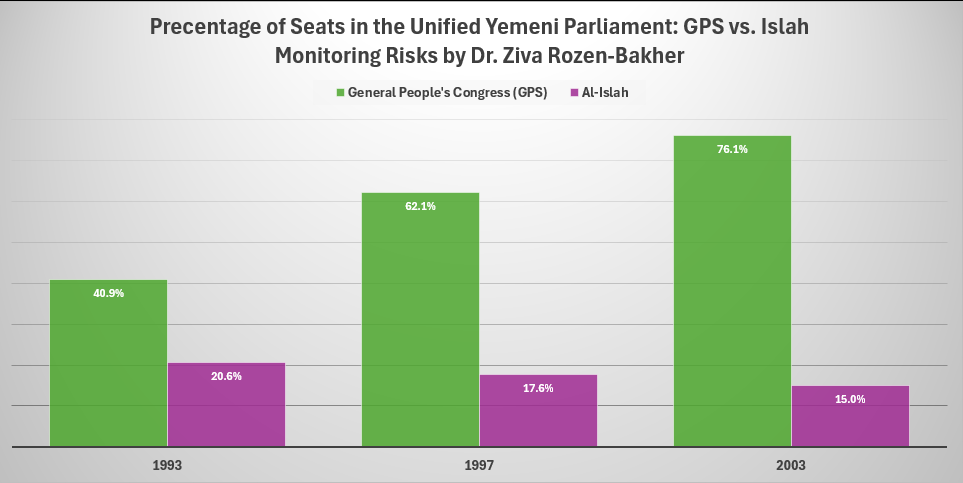
Political Scheme: Forming and Funding the Saudi-Backed Al-Islah, a Yemeni Sunni-Reformist Political Party to Provide Saudi Arabia Control Over Yemen from the “Inside” via the Yemeni Parliament. When the Saudi Economic Scheme did not help to “discipline” Yemen, then Saudi Arabia tried the Political Scheme to get control over Yemen, namely immediately after the unification of Yemen, Saudi Arabia formed and funded the Yemeni political party, Al-Islah (Cite 38), a Saudi-backed Sunni-Reformist Political Yemeni Party to allow Saudi Arabia to control Yemen from the “inside”. More specifically, the unification of Yemen between North Yemen (Sanaa) and South Yemen (Aden) was based on a unity constitution and democratic elections, but Al-Islah has made clear its intention to resist the unified constitution, namely the religious leaders of the north demand sharia for the whole country, while Al-Islah demands secular state (Cite 41), so Saudi Arabia formed the Yemeni political party, Al-Islah, with the aim of getting majority in the unified Yemeni parliament to “control” Yemen from the “inside” (Cite 41). However, this Political Scheme was failed, because the Saudi-backed political Yemeni party, Al-Islah, failed to achieve majority in the first Yemeni parliamentary election after the unification that took place in 1993, while in the next Yemeni Parliamentary Elections its political power even decreased (Cite 38), namely the share of Al-Islah in the Yemeni Parliament decreased from 20.6% in 1993 to 15% in 2003, while the majority of the Northern Political Party, General People's Congress (GPS) (Cite 24) increased in the Parliament from 40.9% in 1993 to 76.1% in 2003, as shown in Chart 2 that compares the percentage of seats in the unified Yemeni Parliament elections between GPS and the Saudi-backed Al-Islah in the elections that took place in 1993, 1997 and the last one in 2003.
Hence, the failure of Saudi Arabia to get “control” over Yemen after the unification via the Economic Scheme (Economic Punishment) and the Political Scheme (Al-Islah) eventually paved the way for the Saudi plan for the regime transformation in Yemen, namely for “Riyadh-Government in Aden”.
Document 1. UNSC Resolution Number 660 on Demanding From Iraq to Withdraw From Kuwait and to Negotiate it via Arab League, 2 August 1990
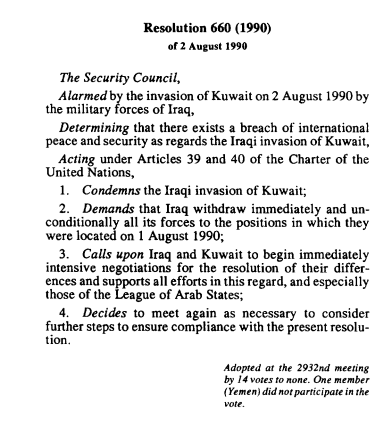
Chart 2. Comparison of the Yemeni Political Parties - General People's Congress (GPS) vs. Saudi-backed Al-Islah - in the Yemeni Unified Parliament: Percentage of Seats in 1993, 1997 and 2003
Section 7. The Yemeni Civil War in 1994: The Refusal of the Yemeni Socialist Party (YSP) to Accept the Democratic Results of the First Yemeni Parliamentary Election after the Unification - The Prelude for ‘Riyadh-Government in Aden‘, 1993-1994
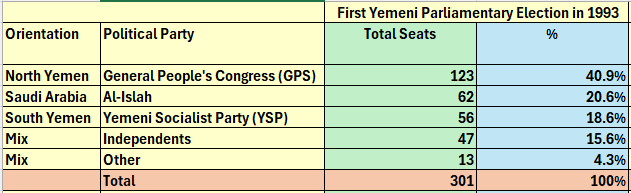
From the start of the unification of Yemen, it was clear that the results of the first Yemeni Parliamentary Election in 1993 will reflect the difference in the Population Size between North Yemen and South Yemen (see Table 1), namely that the political party from North Yemen will have more seats in the unified Yemeni Parliament compared to the political party from South Yemen. It was even clear that the results of the first Yemeni Parliamentary Election in 1993 will reflect the Religious Difference between North Yemen (Sanaa) and South Yemen (Aden), namely that the ‘Shia Political Party‘ from North Yemen will have more seats in the unified Yemeni Parliament compared to the “Reformist-Sunni Political Party”. In other words, despite that it was clear before the unification that the Yemeni Northern party, General People's Congress (GPS) (Cite 24), is going to have the majority in the unified Yemeni Parliamentary, then the Southern party, the Yemeni Socialist Party (YSP) (Cite 39), had the illusion that they will get equal seats despite that South Yemen has only 26.5% of the total Yemen population after the unification. Even the Saudi-backed party Al-Islah had the illusion that the Saudi money will success to get a majority in the unified Yemeni Parliament, despite that it was clear from the start that the ‘Reformist-Sunnis‘ in Yemen have no chance to get majority over the Shiites in Yemen (see Chart 1), because even among the Sunnis in Yemen, there are ‘Traditional-Sunnis‘ particularly in South Yemen versus the Saudi-backed ‘Reformist-Sunnis‘ that stepped into Yemen only after the unification when Al-Islah formed. Therefore, the first election results show that the Northern political party, General People's Congress (GPS), that opposes the Saudi Arabia interference in Yemen gained the majority in the Yemeni Parliamentary with 40.9% of the seats, while the Saudi-backed party Al-Islah got only 20.6% of the seats, and YSP got 18.6% of the seats, as shown in Table 2 that presents the results of the first Yemeni Parliamentary Election in 1993 after the unification.
However, when the Yemeni Socialist Party (YSP) failed to achieve majority in a democratic way, they started a Rebellion (Cite 40 and Cite 41). First, the YSP leaders left from Saana to Aden, and then they established in Aden an informal government like what South Yemen had before the unification, but when the political dispute did not resolve, they started a civil war against North Yemen in 1994 (Cite 40 and Cite 41), so paradoxically, the “Rebels” were YSP and not the Houthis/Ansar Allah (Supporters of God)/North Yemenis, because YSP are those who did not accept the democratic results in 1993 and decided to get control over Yemen via the Yemeni Civil war in 1994. Nevertheless, even the decision of South Yemen to start a Civil War against North Yemen in May 1994 was based on the illusion that South Yemen has the military power to overcome North Yemen, despite that South Yemen has smaller population size (26.5%) compared the larger population size of North Yemen (73.5%). Therefore, only after one month of fighting, in July 1994, the Northern forces captured Aden and overcome the Southern forces (Cite 40). Following that, the leaders of the “Southern Rebels” fled into exile in Saudi Arabia (Cite 41) and the unification of Yemen restored under the Northern Ruling Political Party GPS.
Nevertheless, the results of the first unified Yemeni Parliamentary Election in 1993, along with the Yemeni civil war in 1994, highlight the inability of either Saudi Arabia or South Yemen to control Yemen on their own. South Yemen understood in the hard way that they can not control Yemen in a democratic way or in a military way via rebellion, while Saudi Arabia realized that they can not control Yemen from the ‘Inside‘ via Al-Islah. However, over the years, Saudi Arabia and South Yemen realized that both of them have something in common, namely their wish to control Yemen, so creating a merger between of them via the ‘Riyadh-Government in Aden‘ looks for both of them as a good solution, because South Yemen brings to this merger the formality of ‘Yemen Government‘ despite that it represent only about 20% of Yemeni population, while Saudi Arabia brings to this merger the Saudi army to control Yemen by force, so together with this merger, they can ‘Control‘ Yemen, yet not in a democratic way but only in a military way. However, both Saudi Arabia and South Yemen were needed to wait for an ‘opportunity‘ to form this merger, which indeed came up a decade later when the ‘Arab Spring‘ erupted, which gave the Pretext for Saudi Arabia to carry out the regime transformation in Yemen by installing by force the ‘Riyadh-Government in Aden‘. Hence, the Rebellion of South Yemen via the Yemeni Civil War in 1994 can be considered as a prelude for ‘Riyadh-Government in Aden‘ a decade later.
Table 2. The First Yemeni Parliamentary Election in 1993 after the Unification
Section 8. The ‘Democratic Years‘ in Yemen After the Unification: Yemen Under the Ruling Northern Political Party, General People's Congress (GPS), 1994-2011
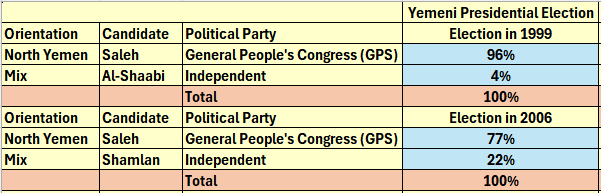
The refusal of the Yemeni Socialist Party (YSP) to accept the democratic results of the unified Yemeni parliamentary election in 1993, led to a short Yemeni Civil War in 1994 when the Northern Forces were needed to take control over the ‘Southern Rebels‘ (Cite 40), which eventually led to the restoration of the unification of Yemen for a decade under the ruling Northern political party, General People's Congress (GPS). During the ‘Democratic Years‘ in Yemen, five democratic elections were conducted in Yemen, as shown in Table 3 that presents the Yemeni Parliamentary election results in 1993, 1997, and 2003, as well as in Table 4 that presents the Yemeni Presidential Election Results in 1999, and 2006. These five democratic elections proved above any doubt that the Northern Political Party, General People's Congress (GPS), can rule all over Yemen in a democratic way if Saudi Arabia does not interfere in the Yemeni affair, while if South Yemen does not start a Rebellion. Importantly, these election results show that over the years, the share of the General People's Congress (GPS) party in the Yemeni Parliament was increased, while the share of Al-Islah and Yemeni Socialist Party (YSP) parties were decreased. On top of that, not only that the political power of Al-Islah and Yemeni Socialist Party (YSP) were decreased over the years in the Yemeni Parliament, but these two parties even did not succeed to bring up candidates that will run against the General People's Congress (GPS) candidates in all the Presidential Yemeni Elections that took place during this period, so in all elections that took place in Yemen after the unification, the General People's Congress (GPS) party won in a big way against Al-Islah and Yemeni Socialist Party (YSP) parties, either in the Yemeni Parliament elections or in the Yemeni Presidential Elections. Most importantly, these election results clearly indicate that any ‘Riyadh-Government in Aden‘ that established by Saudi Arabia after 2015 does not represent the wish of most Yemeni population, namely the Yemeni Elections results show that the ‘Riyadh-Government in Aden‘ or worse the ‘Yemeni Government-Hotel in Riyadh‘ may represent only 15%-20% of the Yemeni population, while at least 75%-80% of the Yemeni population oppose the Saudi military intervention in Yemen.
In the light of the above, the ‘Democratic Years‘ in Yemen between 1994-2011 proves that the unification of Yemen can work under the following four conditions: i) All Yemeni political parties need to accept the results of any democratic election in Yemen without “running” to Aden. ii) South Yemen should accept the reality that always North Yemen will have majority in any unified Yemeni Parliament. iii) Saudi Arabia should not interfere in Yemeni affairs, namely Saudi Arabia and other GCC countries should accept the reality that Yemen is a sovereign republic country with a Shia majority that most of its population located in North Yemen. iv) Saudi Arabia and other GCC countries should accept the reality that any majority in any democratic country determines the policy and the legal system of the country, so Saudi Arabia and other GCC countries should refrain from interfering in Yemeni democratic system and legal system. Otherwise, Yemen should take a step towards de-unification, namely dissolving the Republic of Yemen by returning to the status of two UN members as two independent countries - North Yemen (Sanaa) and South Yemen (Aden) – with each of them holding the same territory as it controlled before the unification of Yemen.
Table 3. Yemeni Parliamentary Election Results in 1993, 1997, and 2003: Number of Seats and Percentage
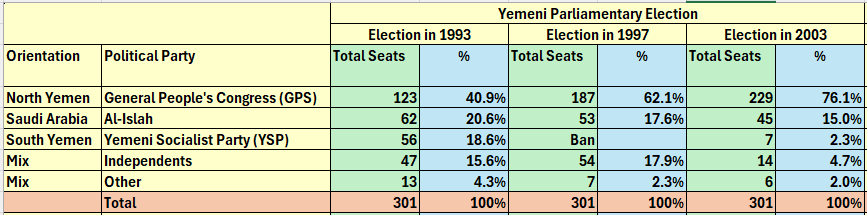
Table 4. Yemeni Presidential Election Results in 1999 and 2006
Section 9. Arab Spring as a Pretext for ‘Regime Transformation by Foreign Actors‘: The Saudi Led ‘GCC Initiative‘ - The Plot to Force the Resignation of the Yemeni President, Saleh, - to Install the ‘Riyadh-Government in Aden‘
‘Regime Transformation by Internal Actors‘ versus ‘Regime Transformation by Foreign Actors‘
A Regime Transformation aims to replace one type of regime into another type of regime, such as in the case of a Regime Transformation from an Absolute Monarchy into a Democratic Republic or in the case of a Regime Transformation from a Democracy into a Military Regime (Cite 46), so a fall of government in democracies or replacing one king with another king, does not consider as a Regime Transformation. Although a Regime Transformation into a ‘Long-Term Provisional Government‘ is also considered as a Regime Transformation, because democratic general elections do not take place under a ‘Long-Term Provisional Government‘, as in the case of Libya when the ‘Long-Term Provisional Government‘ , the Libyan National Transitional Council (NTC), began to rule Libya in 2011. More specifically, during the Arab Spring, a Rebellion took place against Gaddafi, which led immediately, to recognition of the Libyan Rebels by the West, but a month later, a Military Intervention by the USA and NATO took place, with aim of helping the Libyan Rebels to oust Gaddafi. However, since 2011, general democratic elections did not take place in Libya under the ‘Long-Term Provisional Government‘. Worse, the general elections in Libya even have been postponed several times, notably those scheduled for 2018, as well as those scheduled for 2021, so currently, there is a plan to hold an election in Libya in 2027, 16 years after the Libyan National Transitional Council (NTC) began to govern Libya in 2011, yet it is doubtful that the elections will actually take place in 2027. Thereby, we should ask what is the difference between Libya under the Military Regime of Gaddafi and Libya under the Military Regime of the Libyan National Transitional Council (NTC)? We may get an answer by distinguishing between a ‘Regime Transformation by Internal Actors‘ versus a ‘Regime Transformation by Foreign Actors‘.
A ‘Regime Transformation by Internal Actors‘ can take place through Internal Civil Revolution or Internal Military Revolution. An ‘Internal Civil Revolution‘ refers to mass popular protests that lead to the resignation of the leader and even to the flee of the leader outside the country, as in the case of the ‘Internal Civil Revolution‘ in Iran in 1979, when the last Shah of Iran fled the country due to unprecedented popular protests against him, which included about 10% of the Iranian population, a scope of protests uncommon in modern history (Cite 61), resulting in a referendum in Iran with support of 99% of the votes that approved the Regime Transformation in Iran from Monarchy into Republic. In contrast, an ‘Internal Military Revolution‘ refers to an ‘Internal Military Coup‘, either by the state army forces, as in the case of the Carnation Revolution in Portugal in 1974 that was carried out mainly by the middle rank military officers of the Portuguese army, or by ‘Internal Military Junta‘ that takes control over the governmental institutions, as frequently happened in Africa. Anyway a ‘Regime Transformation by Internal Actors‘ occurs due to disagreement with the regime's policies, as in the case of the Portuguese military officers—the Portuguese Rebels—who carried out the Carnation Revolution in Portugal because they opposed Salazar's colonial wars in Africa due to the endless casualties in the Portuguese army, regardless of the negative impact on the Portuguese economy and the violation of human rights by the Portuguese secret police, the PIDA, from which the whole of Portuguese society suffers.
However, a ‘Regime Transformation by Foreign Actors‘ is carried out due to foreign interests. Thus, if we look on various Regime Transformations in the last century, then we will find out that Foreign Actors play significant role in topple regimes, including even democratic regimes when it fit their political and economic interests. Even so, it is not easy to overthrow a regime, especially a Democratic Republic, and particularly when there is a ‘Legitimate Leader‘ who was elected through general democratic elections, so in these cases, the Foreign Actors need - a Pretext - to justify the Regime Transformation that they would like to impose by force on the target country. Still, under any Pretext, the Foreign Actors need to employ a tactic of turning a ‘Legitimate Leader‘ into a ‘Non-Legitimate Leader‘. For example, Trump ordered the USA Army to kidnap President of Venezuela, Maduro, and his Wife, based on a Pretext of fabricated allegation of Drug Trafficking in order to put the USA hands on the Venezuelan Oil (Cite 59). Although, the kidnapping of Maduro came up only after previous failures to carry out a ‘Regime Transformation by Foreign Actors‘ in Venezuela in order to replace Maduro (Cite 59). The first failure refers to the trying to replace President Maduro with the Venezuela's Interim President, Juan Guaido, namely over a few years, many Western countries recognized Juan Guaido as the president of Venezuela instead of the President Nicolás Maduro, so everyone in the West insisted on calling Juan Guaido, the Interim President of Venezuela, while the West referred to Nicolás Maduro as not the President of Venezuela, but eventually this ‘Regime Transformation by Foreign Actors‘ was failed because Maduro had tremendous support in Venezuela (Cite 60). The second and third failures refer to the trying to replace Maduro via Political Assassinations, yet no one declared responsibility for the failed assassination attempt by the 2018 Caracas drone attack and nor for the failed assassination attempt during the 2024 Venezuelan Presidential Election. Nevertheless, kidnapping Maduro by the USA forces can be considered as an ‘External Military Coup‘, namely an ‘Internal Military Coup‘ is carried out either by national army (e.g., Carnation Revolution) or by local militants. In contrast, an ‘External Military Coup‘ is carried out by foreign forces, either by foreign army forces through Military Intervention or by foreign militants that carried out political assassination on behalf of foreign states.
Arab Spring as a Pretext for ‘Regime Transformation by Foreign Actors‘
The Arab Spring that erupted in 2011 gives a perfect “opportunity” for Pretext in order to carried out ‘External Regime Transformation‘ by foreign state actors, as shown in Table X that presents the ‘External Regime Transformation‘ vs. ‘Internal Regime Transformation‘ during the Arab Spring events.
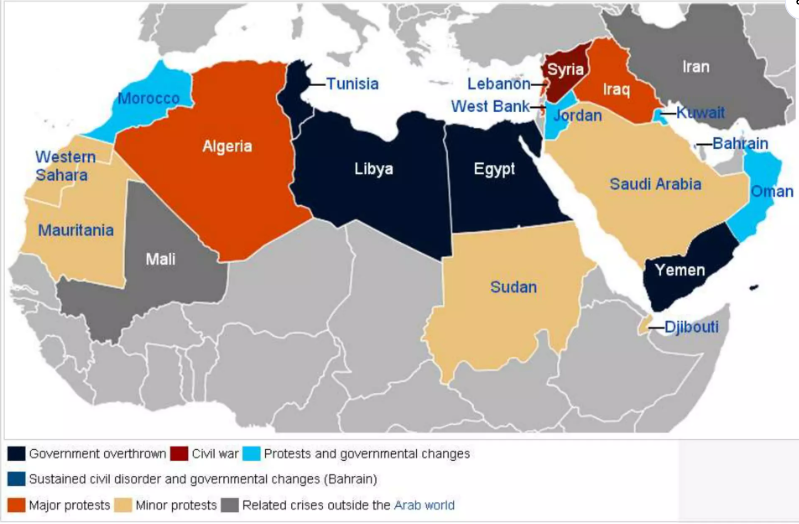
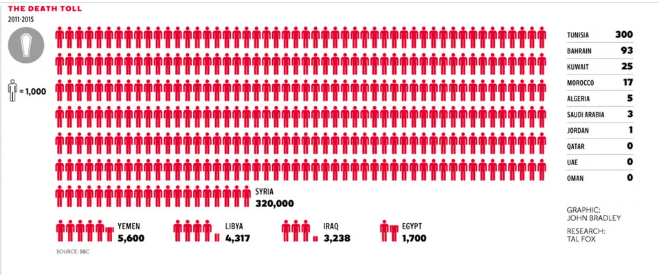
In 2011, the Arab Spring erupted and it lasted for a few years, which includes many Arab countries and non-Arab countries, as shown in Map 8 that presents the countries that involved in the Arab Spring. The Arab Spring was involved mass protests, riots, uprisings, popular revolutions, and rebellions in order to push for governmental reforms that will tackle socio-economic problems, such as high unemployment, and poverty, as well as to push for regime transformation into democracies (Cite 46). During the Arab Spring, countless casualties were recorded in all the countries involved in the Arab Spring events, as shown in Figure 1 that presents the death toll per country. Still, it is important to remember that there is no free press in Absolute Monarchies or even in Semi-Absolute Monarchies, so the information about protests and riots, and their casualties is highly restricted because demonstrations and protests are not permitted in Monarchies. In other words, Monarchies see protests as a threat to their regime due to the fear that it will lead to a regime transformation from Absolute Monarchy into Democratic Republic (Cite 46), so Absolute Monarchies try to hide from the world casualties resulting from protests and riots. The protests and riots of Arab Spring also erupted in Yemen, which led the Yemeni forces to shoot on protesters as done in many Arab countries during the Arab Spring events, resulting in killing protesters as occurred in many Arab countries, such as the mass killing of protests in Rabaa Massacre by the Egyptian forces in 2013, which was command by the current President of Egypt el-Sisi that was the Egyptian Defence Minister at that time. Notably, there is a contradiction between the official Egyptian casualty figures that speak of 638 dead and 3994 wounded (Cite 47) versus other sources that speak of at least 1,000 to 2,600 dead (Cite 48 and Cite 49).
Although any good plan needs also ‘opportunity‘, which came up when the Arab Spring erupted. Thus, the protests and riots of the Arab Spring served as an ‘opportunity‘ for the Saudi Plan - ‘GCC Initiative‘ - for the regime transformation in Yemen, namely the ‘GCC Initiative‘ aimed at forcing the resignation of the President of Yemen, Saleh, by making him as a ‘non-legitimate leader‘ in order to install instead, through Saudi forces, the ‘Riyadh-Government in Aden‘.
However, reinstalling ‘Riyadh-Government‘ is not possible when exists a legitimate government, especially when it is a democratic republic, so the Saudi strategy for a regime transformation is based on the ploy of making the regime/Leader from ‘legitimate‘ to ‘non-legitimate‘. In the case of Syria, Saudi Arabia has an easy task, because Bashar al-Assad was not ‘legitimate Leader‘ in the eyes of many countries worldwide for many years, which even led to the suspension of Syria as a member in OIC and Arab League in 2011-2012 due to the violent actions against civilians by the Syrian government during the Syrian civil war, yet a year before the fall of Bashar al-Assad as the ruler of Syria, the OIC and Arab League reinstall the membership of Syria in 2023-2024.
Although any good plan needs also ‘opportunity‘, which came up when the Arab Spring erupted. Thus, the protests and riots of the Arab Spring served as an ‘opportunity‘ for the Saudi Plan - ‘GCC Initiative‘ - for the regime transformation in Yemen, namely the ‘GCC Initiative‘ aimed at forcing the resignation of the President of Yemen, Saleh, by making him as a ‘non-legitimate leader‘ in order to install instead, through Saudi forces, the ‘Riyadh-Government in Aden‘.
Figure 1. Arab Spring: Death Toll by Country
Map 8. Countries involved in the Arab Spring
The Saudi Led ‘GCC Initiative‘ - The Plot to Force the Resignation of the Yemeni President, Saleh, - to Install the ‘Riyadh-Government in Aden‘
The failure of Saudi Arabia to take control over Yemen in a democratic way via the Saudi-backed Al-Islah party (Cite 38) paved the way for the Saudi plan for Regime Transformation in Yemen when an ‘opportunity‘ came up in 2011 when the Arab Spring rattled the Arab world. It can be argued that the attempt of Saudi Arabia to control Yemen started in 1962 when North Yemen became a Republic (Cite 17), namely Saudi Arabia sees Republics as a threat to their monarchy, especially if it is closed to their territory, so the strategy of Saudi Arabia is that the best solution is to block the regime transformation from monarchy to republic as Saudi Arabia tried to do in the Yemeni Revolution War in 1962-1970 (Cite 18). However, if the ‘Blocking-Republic‘ failed, then the next best solution is trying to reinstall monarchy, such as the latest military backup that Saudi Arabia provided to the USA and Israel in their trying to oust the Islamic Republic of Iran by reinstalling Reza Pahlavi, the Son of the late Shah of Iran (Cite 50, Cite 51, Cite 52). However, if reinstalling monarchy is not possible, then it is better to install a ‘Riyadh-Government‘ to control the country, such as what Saudi Arabia has done in Yemen since 2015 by installing the ‘Riyadh-Government in Aden‘ (Cite 53 and Cite 54) and even recently in Syria by installing the ‘Retired-Terrorists‘ (Cite 55, Cite 56, Cite 57) as a ‘Riyadh-Government in Damascus‘ (Cite 57 and Cite 58), which both get instructions from Saudi Arabia.
However, reinstalling ‘Riyadh-Government‘ is not possible when exists a legitimate government, especially when it is a democratic republic, so the Saudi strategy for a regime transformation is based on the ploy of making the regime/Leader from ‘legitimate‘ to ‘non-legitimate‘. In the case of Syria, Saudi Arabia has an easy task, because Bashar al-Assad was not ‘legitimate Leader‘ in the eyes of many countries worldwide for many years, which even led to the suspension of Syria as a member in OIC and Arab League in 2011-2012 due to the violent actions against civilians by the Syrian government during the Syrian civil war, yet a year before the fall of Bashar al-Assad as the ruler of Syria, the OIC and Arab League reinstall the membership of Syria in 2023-2024.
Despite it, , yet in his which allows Saudi Arabia to install the ‘Riyadh-Government in Damascus‘ with even Saudi-descent ‘Retired-Terrorist‘ as the ‘President of Syria‘ (Cite 57) even without general democratic election. Thereby, for the USA, for example, a ‘Retired-Terrorist‘ as the ‘President of Syria‘ that controlled by Saudi Arabia is better than the Russian-backed Bashar al-Assad, which led the USA and other West governments to remove the Syrian ‘Retired-Terrorists‘ from the List of Terrorists, namely making the ‘Non-Kosher/Non-Halal‘ to ‘Kosher/Halal‘. Nevertheless, in the case of Yemen, Saudi Arabia was needed for more ‘sophisticated plan‘ in order to make the elected President of Yemen, Saleh, who won the Yemeni Presidential election with 77% of the votes, from ‘legitimate leader‘ to ‘non-legitimate leader‘. Although any good plan needs also ‘opportunity‘, which came up when the Arab Spring erupted. Thus, the protests and riots of the Arab Spring served as an ‘opportunity‘ for the Saudi Plan - ‘GCC Initiative‘ - for the regime transformation in Yemen, namely the ‘GCC Initiative‘ aimed at forcing the resignation of the President of Yemen, Saleh, by making him as a ‘non-legitimate leader‘ in order to install instead, through Saudi forces, the ‘Riyadh-Government in Aden‘.
Therefore, here is the timetable of the Saudi Plan - ‘GCC Initiative‘ – for forcing the resignation of the President of Yemen, Saleh, in order to install instead, through Saudi forces, the ‘Riyadh-Government in Aden‘, as follows:
2011, Arab Spring Riots in Yemen. In 2011, the Arab Spring erupted and it lasted for a few years, which includes many Arab countries and non-Arab countries, as shown in Map 8 that presents the countries that involved in the Arab Spring. The Arab Spring was involved mass protests, riots, uprisings, popular revolutions, and rebellions in order to push for governmental reforms that will tackle socio-economic problems, such as high unemployment, and poverty, as well as to push for regime transformation into democracies (Cite 46). During the Arab Spring, countless casualties were recorded in all the countries involved in the Arab Spring events, as shown in Figure 1 that presents the death toll per country. Still, it is important to remember that there is no free press in Absolute Monarchies or even in Semi-Absolute Monarchies, so the information about protests and riots, and their casualties is highly restricted because demonstrations and protests are not permitted in Monarchies. In other words, Monarchies see protests as a threat to their regime due to the fear that it will lead to a regime transformation from Absolute Monarchy into Democratic Republic (Cite 46), so Absolute Monarchies try to hide from the world casualties resulting from protests and riots. The protests and riots of Arab Spring also erupted in Yemen, which led the Yemeni forces to shoot on protesters as done in many Arab countries during the Arab Spring events, resulting in killing protesters as occurred in many Arab countries, such as the mass killing of protests in Rabaa Massacre by the Egyptian forces in 2013, which was command by the current President of Egypt el-Sisi that was the Egyptian Defence Minister at that time. Notably, there is a contradiction between the official Egyptian casualty figures that speak of 638 dead and 3994 wounded (Cite 47) versus other sources that speak of at least 1,000 to 2,600 dead (Cite 48 and Cite 49).
10 March 2011, The Yemeni President Saleh Announced that a Referendum is going to take place on a New Constitution to separate the Executive and Legislative powers. The new constitution was aimed to give the Yemeni parliament more power in relation to laws, as exist in many Republican Democracies. However, paradoxically, those who do not like democracies, unlikely like this forthcoming new constitution.
03 June 2011, Assassination Attempt of the Yemeni President Saleh and his Cabinet by Bombs Exploded in the Presidential palace and inside a Mosque in Sanaa when the President and his Cabinet were Praying, resulting in Killing many People, yet the President Survived with Injuries. This assassination attempt can be considered as an attempt for Coup d'etat in Yemen because it aimed to kill the Yemeni President Saleh and his cabinet to create “vacuum” for a new regime in Yemen. However, this Coup d'etat failed because the Yemeni President Saleh survived and even return to function after recovery of three months, which paved the way for seeking another alternative to oust the Yemeni President Saleh by those who seek regime transformation in Yemen. We can ask Who is responsible for this Coup d'etat in Yemen? We can suggest many assumptions and conspiracy theories, but one thing is certain—Ansar Allah (“Supporters of God”) or as the West calls them, the “Houthis”—would never bomb a mosque, while Al-Qaeda—that many of its members located in Saudi Arabia—has no problem to bomb Mosques or even much more than that, such the 9/11 attacks. Still, if it is indeed Al-Qaeda, then the big question is who gave them the order to conduct the Coup d'etat in Yemen in 2011.
04 June 2011, The Yemeni Vice President Hadi was appointed as acting president, yet Saleh remained the president of Yemen during his Health Recover From the Assassination Attempt. The Yemeni President Saleh suffered from significant injuries, so during his recovery, Hadi functioned as the acting president, yet even during the recovery period, Saleh was involved in the decision-making.
23 September 2011, The Yemeni President Saleh Resumed his Duties as the President of Yemen upon his Return to Yemen after Receiving Medical Treatment abroad. After three months of Medical Treatment due to the injuries from the assassination attempt, Saleh resumed his duties as the President of Yemen, but only a month later he was needed to deal with an additional “Oust” via the “Saudi-Led GCC Initiative”.
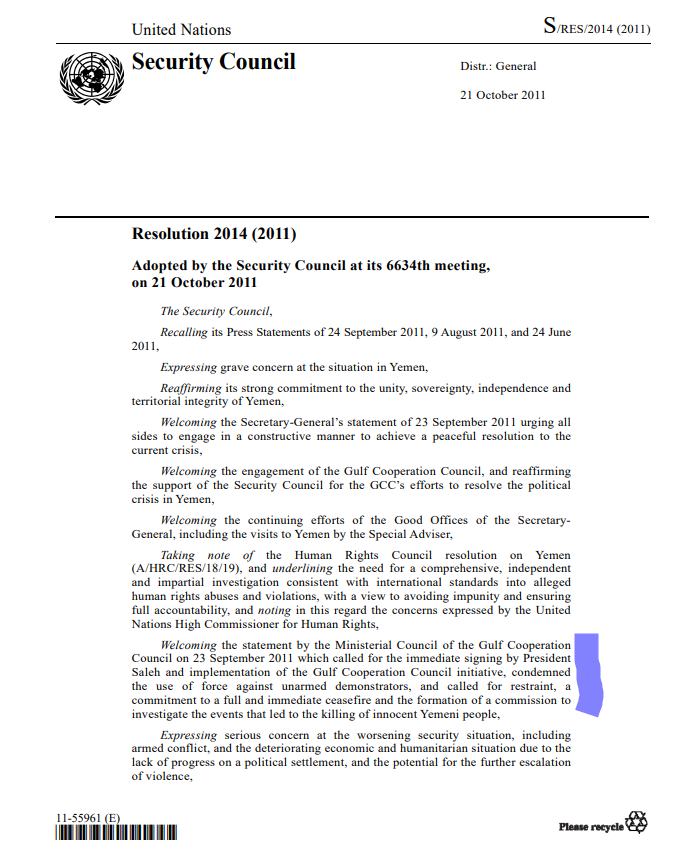
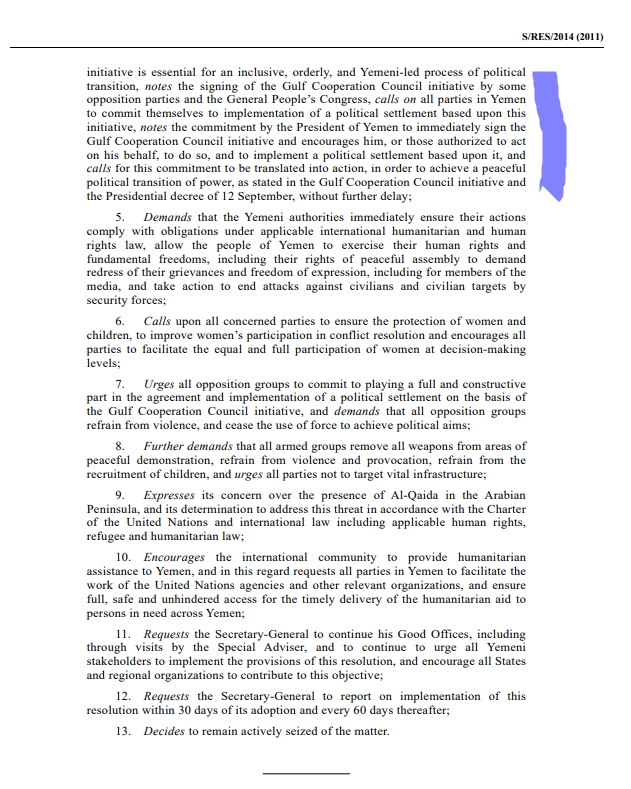
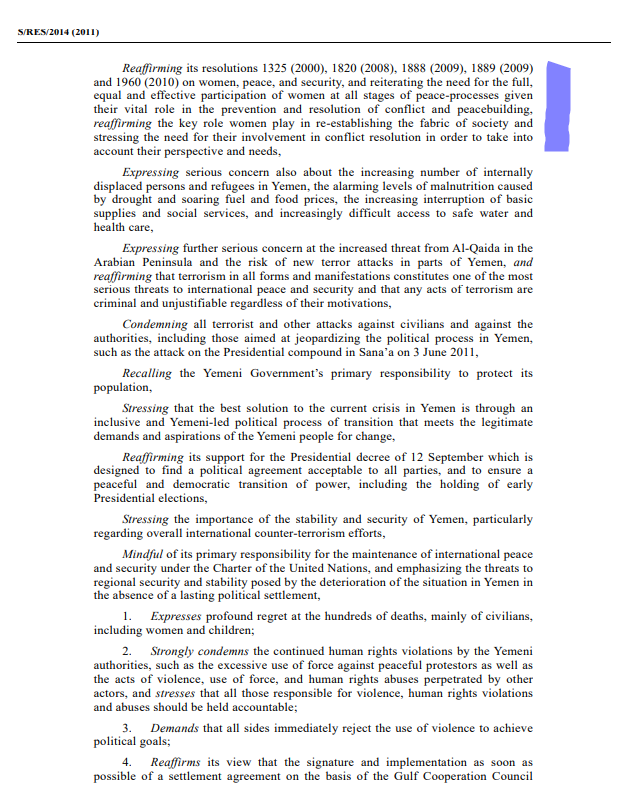
21 October 2011, UNSC Resolution no. 2014: Demanding from the Elected Yemeni President Saleh (won 77% in 2006 Election) to Resign from his Post Under the Pretext of Shooting on Protesters during the Riots of Arab Spring, and that the Transfer of Power will be based on the “Saudi-Led GCC Initiative”. Only one month after Saleh resumed his duties as the President of Yemen, Saudi Arabia and GCC countries pushed for the UNSC resolution 2014 based on the “Saudi-Led GCC Initiative”, as shown in Document X, which demands from the Elected Yemeni President Saleh that won 77% of the votes in the 2006 Presidential Election to resign from his post, because the Yemeni forces shot on protesters during the riots of Arab Spring. Importantly, this resolution even demands that the Transfer of Power of the Elected Yemeni President Saleh should be based on the “Saudi Arabia-Led GCC Initiative”. First, we should ask how it is possible that a group of neighboring countries bring up a UNSC resolution that its outcome is equivalent to the failure of the Coup d'etat only four months earlier. In other words, the assassination attempt aims to oust Saleh, but paradoxically, also the Saudi-Led GCC Initiative aims to oust Saleh. We can wonder why GCC countries did not help Yemen in fighting against an additional Coup d'etat, and instead, GCC countries gave a “prize” for those who carried out the Coup d'etat in Yemen in a style of terrorist attack by demanding from the Elected Yemeni president Saleh to resign under the pretext of shooting on protesters. To illustrate it, how it would perceive, if a group of Latin American countries would bring up a UNSC resolution that demands the resignation of the President of Brazil, Lula, following the failure assassination attempt that was carried out in December 2022, just a few weeks before Lula took office, namely those who conducted the assassination attempt against Lula tried to oust Lula even before he started his term. Second, we should ask in how many cases, the UNSC passed resolution that demand from Elected Head of State to resign due to shooting on protesters, based on a “Plan” of neighbouring countries. To illustrate it, how it will perceive if Germany pushes to UNSC Resolution that demands the resignation of President France Macron due to the casualties among young protesters in the recent riots in France. Besides, despite the Israeli genocide in Gaza, Saudi Arabia and GCC countries did not bring up UNSC resolution that demands the resignation of Netanyahu based on a GCC Initiative, despite the Arrest Warrant against him by ICC. Second, we should also ask if Absolute Monarchies like the GCC countries that has no general election at all can demand resignation from head of state that was elected in democratic republic election. Worse, the GCC Absolute Monarchies not only demanded the resignation of the elected Yemeni President, but they also demanded that the Transfer of Power will be based on GCC Initiative. Is it a good idea that Absolute Monarchies like Saudi Arabia that have no experience in how to run republics or democratic election will demand Transfer of Power based on their “Initiative”? Unclear if the “GCC Initiative” for Transfer of Power in Yemen was based on the rational of an Absolute Monarchy, namely that democratic election is not needed, which may explain why from 2015 until today, the “Riyadh-Government in Aden” did not conduct any election from 2015 until today. However, the most ridicules issue in this “GCC Initiative Resolution” was the demand for Equal Rights to Yemeni Women. In this case we should ask how a country like Saudi Arabia can demand equal rights for women from another country in 2011 when women in Saudi Arabia were still prohibited from driving a car in 2011, as well as women in Saudi Arabia were prohibited from voting or being candidates in the Saudi Arabia municipal election, the only election that exists in Saudi Arabia. More specifically, since the establishment of the Yemeni Republic, Yemeni women have had the right to vote in any election, including being candidates, regardless of their right to drive a car. However, in the Absolute Monarchy Saudi Arabia, only from 2015, women in Saudi Arabia have the right to vote and being candidates in the Saudi municipal election, while Saudi Arabia was the only country in the world that prohibited from women to drive a car until 2018 when the Saudi “Women to Drive Movement” pushed for change this unequal Saudi law.
23 November 2011, Following the UN Resolution, the Elected Yemeni President Saleh Forced to Agree to Resign from his Post based on “Saudi-Led GCC Initiative”. On 23 November 2011, following the UN Resolution Two Days Earlier, the Yemeni President Saleh forced to sign on the Saudi-Led GCC Initiative that demands his resignation, which paved the way for the start of the regime transformation in Yemen. Clearly that the “Saudi-Led GCC Initiative” is a case of an unprecedented interfering in the internal affairs of a sovereign state, namely in how many countries, an elected head of state forced to resign from his post by signing it in a neighbouring country. Hence, it can be argued that the failure of Saudi Arabia to control Yemen in a democratic way via election, led them to “invent” the GCC Initiative for Regime Transformation in Yemen when the “Opportunity” came up.
Document X. UNSC Resolution 2014, 21 October 2011: Demanding from the Elected Yemeni President Saleh (won 77% in 2006 Election) to Resign from his Post due to Shooting on Protesters during the Riots of Arab Spring, and the Transfer of Power should be based on the Initiative of Saudi Arabia and GCC Countries; Demanding Equivalent Rights to Yemeni Women
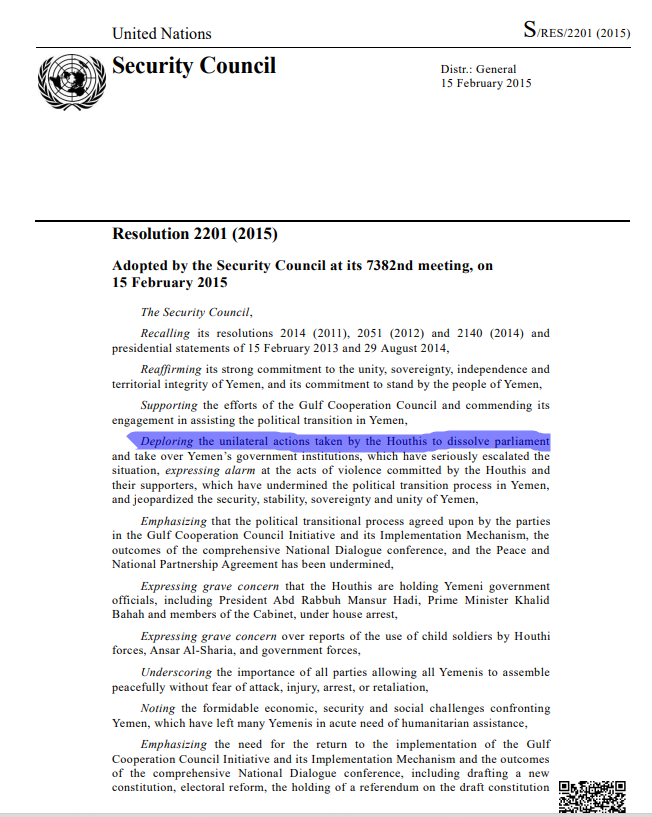
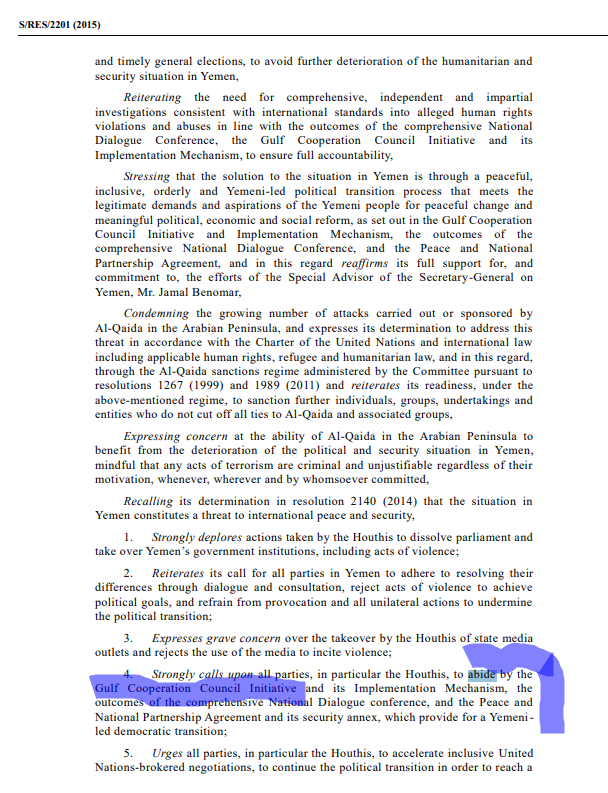
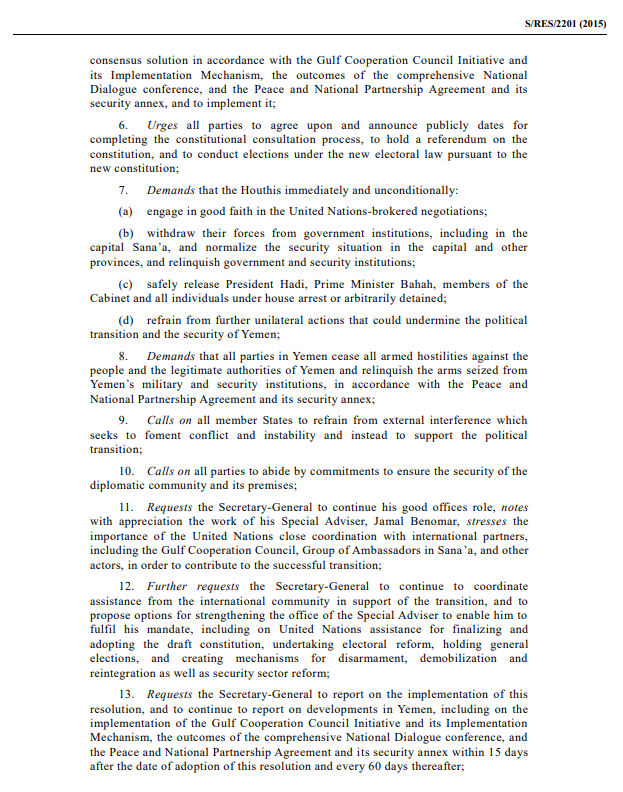
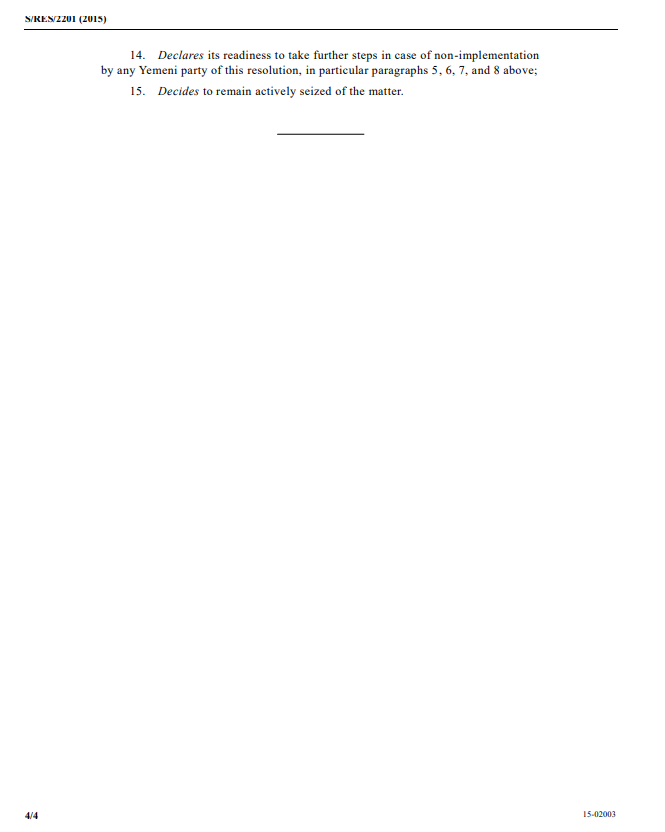
Document X. UNSC Resolution 2201, 15 February 2015: Condemnation about Dissolving the Yemeni Parliament after 12 Years without Election and Demanding that the Yemeni Government will Abide to GCC Countries
However, a Regime Transformation from a Democratic Republic into ‘Long-Term Provisional Government‘, as in the cases of Yemen and Syria also consider as a Regime Transformation. More specifically, in a Democratic Republic, the government and the head of state appointed through general elections, while a ‘Long-Term Provisional Government‘ does not appointed through general elections, namely the Foreign Actors that carried out the Regime Transformation de-facto appointed and replaced the ‘Long-Term Provisional Government‘. Thereby, in the case of Yemen, until the Saudi Regime Transformation in Yemen, Yemen had general elections (see previous section) until the Saudi Regime Transformation in Yemen in 2015, while since then, for more than ten years, Yemen has ‘Long-Term Provisional Government‘ without carrying out any general elections, namely since 2015, Yemen has a ‘Riyadh-Government in Aden‘. Syria also had general elections under the regime of Bashar al-Assad, even in a war time, namely Assad took advantage on the ceasefire break during the Syrian war against Islamic State, and conducted a general election in 2016, since the ‘Regime Transformation by Foreign Actors‘ in Syria, the Saudi-backed ‘Long-Term Provisional Government‘ in Syria, has no intention to conduct general elections until at least 2030, so de-facto the ‘Long-Term Provisional Government‘ in Syria is like a ‘Riyadh-Government in Damascus‘. Thereby, we should ask, Why Yemen has no general elections since 2015?, or Why Syria has no intention to conduct general elections until at least 2023?, or Why Libya has no general elections since the appointment of the ‘Long-Term Provisional Government‘ (National Transitional Council (NTC)) in 2011? Therefore, it can be argued that those who fear to lose in general elections, used a war as an excuse to not carry out general elections in order to stay in power, such as the criticism against Zelenskyy that he did not carry out a general election because he is clearly going to lose the power in any next general election in Ukraine, so Ukraine is a case of a Regime Transformation from a Democratic Republic into an Autocracy. Even Foreign Actors that carried out a Regime Transformation in a certain country, have no interest in a general democratic elections, because they will lose control on the country, such as in the case of Yemen, Syria, and Libya. Hence, Saudi Arabia control Yemen and Syria through the ‘Long-Term Provisional Government‘ that de-facto operate as ‘Riyadh-Government‘.
Section 10. The Saudi Military Intervention in Yemen: Controlling South Yemen by Saudi Forces and Saudi Mercenaries to Maintain by Force the ‘Riyadh-Government in Aden‘, while Trying to Conquest North Yemen by Saudi Bombarding, Blockade, and Starvation – Is Saudi Arabia Committed Genocide in North Yemen?, 2015-2022
Although it can be argued that Saudi Arabia waited for the “opportunity” to renew its military intervention in Yemen after its failure in 1962-1970 and in the failure by the Southern rebellion in 1994.
To understand why it was ‘opportunity‘, we should ask in how many countries a military intervention took place under the following circumstances. In July 2014, Hadi’s administration cut the fuel subsidies, leading to significant protests in Sanaa, which eventually led to killing of protesters when the Yemeni security forces opened fire on the protesters. Following that, the president resigned due to shooting on protests and the Yemeni parliament was dissolved after 12 years without election, namely the Yemeni parliament dissolved in 2015 when the last Yemeni parliamentary election was in 2003, while five-member presidential council were picked to form a transitional government until the next election. Besides, the president put on house arrest to investigate the shooting on protests and other issues, namely the Yemeni president Hadi put on house arrest to investigate its wrong doing. Hence, all these circumstances do not justify a military intervention, but in the case of Yemen, Saudi Arabia did not wait for “Normal Democratic Process” that was supposed to take place in Yemen, namely conducting new election following dissolving the parliament, which is a normative democratic process, especially when the last election took place 12 years before. Thus, instead, Saudi Arabia pushed for UNSC resolution 2201 that condemns the dissolving the Yemeni parliament, including demand that Yemen will abide to GCC countries, as shown in Document X that presents the UNSC resolution 2201. Immediately after that, Saudi Arabia seized the “opportunity” to took control over Yemen by invading Yemen and establishing the “Riyadh-Government in Aden”. However, North Yemen did not agree to abide to Saudi Arabia and GCC countries, so since then, over 12 years until today, there is a war between the North Yemen Forces and Saudi Forces in Yemen. During this long war, Saudi Arabia used all the methods to take over North Yemen through destroying North Yemen by unprecedented bombarding, total blockade that led to starvation and famine due to lack of food, and even to illness and pandemic (e.g., Cholera) due to lack of humanitarian aid, which result in about 1 million casualties among the North Yemen population, including death of app. 100,000 North Yemeni children below 5 years old from starvation and famine, so many human rights organizations refer to what Saudi Arabia done in North Yemen as Genocide.
Section 11. Peace Deal between North Yemen and Saudi Arabia, 2022-2026
Section 12. The Liberation War by North Yemen against the Saudi Forces and Saudi Mercenaries in Yemen, 2026-Current
However, keep in mind that it is possible that most of Yemeni territories may be liberated in the near future by the North Yemen forces, as happened during the Yemeni Revolution in 1962 and in
Section 13. Summary
Since Saudi Arabia establishment in 1932, king comes and king gone, but the Saudi policy toward Yemen has remained unchanged—‘Keeping Control Yemen‘—whether economically, politically, or even militarily, so controlling Yemen is one of the fundamental pillars of the Saudi strategy for preserving the Saudi monarchy and its hegemony in the Gulf.
In the light of the above, the ‘Democratic Years‘ in Yemen between 1994-2011 proves that the unification of Yemen can work under the following four conditions: i) All Yemeni political parties need to accept the results of any democratic election in Yemen without “running” to Aden. ii) South Yemen should accept the reality that always North Yemen will have majority in any unified Yemeni Parliament. iii) Saudi Arabia should not interfere in Yemeni affairs, namely Saudi Arabia and other GCC countries should accept the reality that Yemen is a sovereign republic country with a Shia majority that most of its population located in North Yemen. iv) Saudi Arabia and other GCC countries should accept the reality that any majority in any democratic country determines the policy and the legal system of the country, so Saudi Arabia and other GCC countries should refrain from interfering in Yemeni democratic system and legal system. Otherwise, Yemen should take a step towards de-unification, namely dissolving the Republic of Yemen by returning to the status of two UN members as two independent countries - North Yemen (Sanaa) and South Yemen (Aden) – with each of them holding the same territory as it controlled before the unification of Yemen.
Hence, it can be argued that the attempt of Saudi Arabia to control Yemen started in 1962 when North Yemen became a Republic, namely Saudi Arabia sees Republics as a threat to their monarchy, especially if it is closed to their territory, so the strategy of Saudi Arabia is that the best solution is to block the regime transformation from monarchy to republic as Saudi Arabia tried to do in the Yemeni Revolution War in 1962-1970. However, if the ‘Blocking-Republic‘ failed, then the next best solution is trying to reinstall monarchy, such as the latest military backup that Saudi Arabia provided to the USA and Israel in their trying to oust the Islamic Republic of Iran by reinstalling Reza Pahlavi, the Son of the late Shah of Iran. However, if reinstalling monarchy is not possible, then it is better to install a ‘Riyadh-Government‘ to control the country, such as what Saudi Arabia has done in Yemen since 2015 by installing the ‘Riyadh-Government in Aden‘ and even recently in Syria by installing the ‘Retired-Terrorists‘ as a ‘Riyadh-Government in Damascus‘, which both get instructions from Saudi Arabia. Therefore, under the ‘Riyadh-Government‘ doctrine, Saudi Arabia de-facto control and run Yemen and Syria like Colonies, including benefiting from controlling their Votes in the UN, so today, Saudi Arabia not only has its vote in any UN vote, but it also has like three votes, which include also Yemen and Syria that both of them vote in the UN according to the instructions from Saudi Arabia.
In the light of the above, it can be argued that the attempt of Saudi Arabia to control Yemen by declaring North Yemen as “rebels” while installing “Riyadh-Government in Aden” started in 1962 when North Yemen became a Republic. In other words, Saudi Arabia sees Republics as a threat to their monarchy, especially if it is closed to their territory, so the strategy of Saudi Arabia is that reinstalling monarchy is the best solution, such as the latest military backup that Saudi Arabia provided to the USA and Israel in their trying to oust the Islamic Republic of Iran by reinstalling Reza Pahlavi, the Son of the late Shah of Iran. However, if reinstalling monarchy is not possible, then it is better to install a “Riyadh-Government” to control the country, such as what Saudi Arabia has done in Yemen since 2015 by installing the “Riyadh-Government in Aden” and even recently in Syria by installing the “Retired-Terrorists” as a “Riyadh-Government in Damascus”, which both get instructions from Saudi Arabia. Although in the case of the “Riyadh-Government in Aden”, they even started the operate their activities in hotels in Riyadh as a “Yemeni Government-Hotel in Riyadh” instead of in Aden, which explained the huge differences between North Yemen and South Yemen in related to Saudi Arabia, namely North Yemen opposes any trying to make them like a Colony of Saudi Arabia, while South Yemen is a different story. South Yemen was a British Colony from 1838 until 1967, and even as an Independent Country, South Yemen mainly depended on Foreign Aid, so South Yemen has no problem to operate as a Colony of Saudi Arabia via “Riyadh-Government in Aden” or even worse as a “Yemeni Government-Hotel in Riyadh”, especially when it gives for South Yemen “control” all over Yemen, despite that the “Riyadh-Government in Aden” does not represent the majority of Yemeni population. In other words, under the democratic system in Yemen, South Yemen can get maximum 20% of the Yemeni parliament seats, while Saudi Arabia has no say. However, under the “Riyadh-Government”, South Yemen represents Yemen in the UN and North Yemen are the “Rebels”, while Saudi Arabia de-facto controls and runs Yemen like a Colony, including benefiting from controlling the Votes of Yemen in the UN, so today, Saudi Arabia not only has its vote in any UN vote, but it also has like three votes, which include Yemen and Syria that both of them vote in the UN according to the instructions from Saudi Arabia.
Section 14. Citations
Cite 1. Burrowes, R. D. (2016). The Yemen Arab Republic: The Politics of Development, 1962-1986. Routledge.
Cite 2. Burrowes, R. D. (1991). Prelude to Unification: The Yemen Arab Republic, 1962–1990. International Journal of Middle East Studies, 23(4), 483-506.
Cite 3. North Yemen (Sanaa), Rozen-Bakher, Z., Blog on Foreign Direct Investment (FDI) and International Trade by Dr. Ziva Rozen-Bakher, Cycle I, 08 April 2025, https://www.rozen-bakher.com/blog/08042025/north-yemen-sanaa
Cite 4. Ismael, T. Y. (1981). People’s Democratic Republic of Yemen. In Marxist Governments: Volume 3: A World Survey (pp. 755-783). London: Palgrave Macmillan UK.
Cite 5. Anthony, J. D. (2020). The Communist Party Of The People’s Democratic Republic of Yemen: An Analysis if Its Strengths And Weaknesses. In Contemporary Yemen (pp. 232-239). Routledge.
Cite 6. South Yemen (Aden), Rozen-Bakher, Z., Blog on Foreign Direct Investment (FDI) and International Trade by Dr. Ziva Rozen-Bakher, Cycle I, 09 April 2025, https://www.rozen-bakher.com/blog/09042025/south-yemen-aden
Cite 7. El Mallakh, R. (2014). The Economic Development of the Yemen Arab Republic (RLE Economy of Middle East). Routledge.
Cite 8. Lewis, J. (1987). People's Democratic Republic of Yemen: struggle for survival. Geography, 72(4), 360-363.
Cite 9. Mawby, S. (2006). British Policy in Aden and the Protectorates 1955-67: Last outpost of a Middle east empire. Routledge.
Cite 10. Halevi, L. (2023). Arabians for guns: Wahhabi matchlocks, world trade, and the rise of the first Saudi state. Journal of the Royal Asiatic Society, 33(2), 401-442.
Cite 11. Na, N. (2015). Saudi Arabia in the nineteenth century. Springer.
Cite 12. Philby, H. S. J. (1926). The triumph of the Wahhabis. Journal of the Central Asian Society, 13(4), 293-319.
Cite 13. Al-Enazy, A. H. (2005). The long road from Taif to Jeddah: resolution of a Saudi-Yemeni boundary dispute. Emirates Center for Strategic Studies and Research.
Cite 14. Rabi, U. (2014). Yemen: Revolution, civil war and unification. Bloomsbury Publishing.
Cite 15. Rogers, J., Jones, M. O., Porter, R., & Valeri, M. (2018). Importing the revolution: Institutional change and the Egyptian presence in Yemen 1962–1967. The Gulfization of the Arab World, 113-33.
Cite 16. Sellin, V. (2017). Violence and legitimacy: European monarchy in the age of revolutions. Walter de Gruyter GmbH & Co KG.
Cite 17. Badeeb, S. M. (2019). The Saudi-Egyptian Conflict Over North Yemen, 1962-1970. Routledge.
Cite 18. Percze, M. (2024). The role of Saudi Arabia and Egypt in the Yemeni civil wars. Journal of Central and Eastern European African Studies.
Cite 19. Witty, D. M. (2017). A regular army in counterinsurgency operations: Egypt in North Yemen, 1962–1967. In Warfare in the Middle East since 1945 (pp. 413-451). Routledge.
Cite 20. Fighting in Yemen Is Reported Ended By Saudi Accord, New York Times, 15 April 1970
Cite 21. Mubarez, A. M. (1992). Foreign policy making in the Yemen Arab Republic civil war period: A study of four major decisions. London School of Economics and Political Science (United Kingdom).
Cite 22. Wenner, M. W. (2020). The 1986 Civil War in South Yemen: A Preliminary Assessment. In The Arab Gulf and the Arab World (pp. 268-291). Routledge.
Cite 23. Burrowes, R. D. (1989). Oil Strike and Leadership Struggle in South Yemen: 1986 and Beyond. Middle East Journal, 43(3), 437-454.
Cite 24. Dunbar, C. (1992). The unification of Yemen: process, politics, and prospects. Middle East Journal, 46(3), 456-476.
Cite 25. Addleton, J. (1991). Economic prospects in a United Yemen. Journal of South Asian and Middle Eastern Studies, 14(4).
Cite 26. Halliday, F. (1986). Catastrophe in South Yemen: a preliminary assessment. MERIP Middle East Report, (139), 37-39.
Cite 27. Bordón, J., & Alrefai, E. (2024). Saudi Arabia’s foreign aid: The singularity of Yemen as a case study. Third World Quarterly, 45(15-16), 2228-2245.
Cite 28. Rozen-Bakher, Z. North Yemen (Sanaa) List, Twitter-X Lists of Dr. Ziva Rozen-Bakher via the Twitter-X Account @ZivaRozenBakher, https://www.rozen-bakher.com/identify-risks/yemen-sanaa-list Note, Dr. Ziva Rozen-Bakher follows this list on X on a daily basis, which allows her to gain a broad perspective on the Tribes in North Yemen, as well as on the war between the Saudi forces and the Northern Yemen forces.
Cite 29. Rozen-Bakher, Z. South Yemen (Aden) List, Twitter-X Lists of Dr. Ziva Rozen-Bakher via the Twitter-X Account @ZivaRozenBakher, https://www.rozen-bakher.com/identify-risks/yemen-aden-list Note, Dr. Ziva Rozen-Bakher follows this list on X on a daily basis, which allows her to gain a broad perspective on the Tribes in South Yemen, as well as on the war between the Saudi forces and the Northern Yemen forces, as well as between the Saudi forces and Southern Separatists (e.g., Southern Transitional Council (STC) that formally dissolved but it still active)
Cite 30. Dahlgren, S. (2018). The Southern Transitional Council and the War in Yemen. ReliefWeb. April, 26, 2018.
Cite 31. Criminals-turned-Saudi mercenaries terrorise Yemen's Taiz province, Middle East Eye, 03 July 2020.
Cite 32. Gangsters in war-torn Yemen ensnare women to do their dirty work. Middle East Eye, 29 March 2022.
Cite 33. Yemen’s Taiz on Verge of Liberation by Ansarullah Forces, Tasnim News Agency, 01 October 2026.
Cite 34. Nonneman, G. (1997). The Yemen Republic: From Unification and Liberalization to Civil War and Beyond. In The Middle East in the New World Order (pp. 61-96). London: Palgrave Macmillan UK.
Cite 35. Hartmann, R. (1995). Yemeni Exodus from Saudi-Arabia: The Gulf Conflict and the Ceasing of the Workers' Emigration. Journal of South Asian and Middle Eastern Studies, 19(2).
Cite 36. Yemenis Feel Brunt of Arab Split, Christian Science Monitor, 29 October 1990
Cite 37. Van Hear, N. (1994). The socio-economic impact of the involuntary mass return to Yemen in 1990. Journal of Refugee Studies, 7(1), 18-38.
Cite 38. Schwedler, J. (2004). The Islah Party in Yemen. Islamic activism: A social movement theory approach, 205-228.
Cite 39. Lackner, H. (2017). The people’s democratic republic of Yemen: Unique socialist experiment in The Arab World at a time of world revolutionary fervour. Interventions, 19(5), 677-691.
Cite 40. Al-Suwaidi, J. S. (2013). The Yemeni war of 1994: causes and consequences. ZAWYAT ALMAARFEH.
Cite 41. Parodi, C. A., Rexford, E., & Van Wie Davis, E. (1994). The silent demise of democracy: the role of the Clinton administration in the 1994 Yemeni Civil War. Arab Studies Quarterly, 65-76.
Cite 42. Mamoun, F. Yemen's War, Democracy's Loss. The Christian Science Monitor, 12 May 1994.
Cite 43. Al-Enazy, A. H. (2002). “The international boundary treaty”(treaty of Jeddah) concluded between the Kingdom of Saudi Arabia and the Yemeni Republic on June 12, 2000. American Journal of International Law, 96(1), 161-173.
Cite 44. Al-Enazy, A. H. (2005). The long road from Taif to Jeddah: resolution of a Saudi-Yemeni boundary dispute. Emirates Center for Strategic Studies and Research.
Cite 45. Has the Liberation of Jizan, Najran, and Asir Started?. Kayhan International, 31 May 2021.
Cite 46. Rozen-Bakher, Z. (2021). A Regime Type as a Location Factor of FDI: Democracy, Communism, Absolute Monarchy, Religious Regime, and Military Regime. Unpublished Research Paper, PD5. https://www.rozen-bakher.com/unpublished-research-papers/pd5
Cite 47. Health Ministry raises death toll of Wednesday's clashes to 638. Daily News Egypt. 21 August 2013.
Cite 48. Rabaa: The massacre that ended the Arab Spring, Middle East Eye, 14 August 2018.
Cite 49. Egypt’s Brotherhood to hold ‘march of anger’, Al Jazeera ,16 August 2013.
Cite 50. Rozen-Bakher, Z., The CIA’s Illusion about Restoring the Iranian Autocratic Monarchy through Reza Pahlavi, the Son of the late Shah of Iran, Risks Timeline by Dr. Ziva Rozen-Bakher, 08 January 2026, https://www.rozen-bakher.com/timeline-risks/12/01/2026/0538
Cite 51. Former confidant claims Reza Pahlavi was funded by Saudi Arabia and CIA. Kodoom, 05 July 2018.
Cite 52. Saudi Arabia expands US base access, UAE prepares for months-long Iran war. 21 March 2026.
Cite 53. Oxford Analytica. (2024). Aden-based government faces serious unrest. Emerald Expert Briefings.
Cite 54. Al-Deen, M. S. (2023). The Presidential Council’s Year of Failure’. Sana’a Center For Strategic Studies.
Cite 55. Hardy, R. (2025). From jihad to politics: how Syrian jihadis embraced politics. International Affairs, Volume 101, Issue 5, September 2025, Pages 1943–1944.
Cite 56. Drevon, J. (2024). From jihad to politics: How Syrian Jihadis embraced politics (p. 288). Oxford University Press.
Cite 57. From al-Qaeda terrorist to 1st Syrian to address UNGA in 60 years: Who is Ahmed al-Sharaa?. WION, 25 September 2025.
Cite 58. Saudi Arabia’s Shrewd Embrace of Ahmed Al Sharaa. Gulf International Forum (GIF), 19 February 2025.
Cite 59. Rozen-Bakher, Z., Did Trump kidnap President of Venezuela Nicolás Maduro and his Wife due to Drug Trafficking or for Venezuelan Oil?, Risks Timeline by Dr. Ziva Rozen-Bakher, 07 January 2026, https://www.rozen-bakher.com/timeline-risks/07/01/2026/0542
Cite 60. Rozen-Bakher, Z., Can External Players Topple a Leader in a Rival Country? Venezuela Interim President, Risks Timeline by Dr. Ziva Rozen-Bakher, 25 April 2023, https://www.rozen-bakher.com/timeline-risks/25/04/2023/1641
Cite 61. Kurzman, C. (2003). The Qum protests and the coming of the Iranian Revolution, 1975 and 1978. Social Science History, 27(3), 287-325.